

Hawker Food on Singapores cultural and social landscape represents far more than affordable street meals it is a living symbol of the nation’s identity, diversity, and everyday life. From bustling hawker centres in Chinatown and Little India to neighbourhood food courts across the island, hawker food reflects Singapore’s multicultural heritage, blending Chinese, Malay, Indian, and Peranakan influences into a shared culinary tradition. Dishes like Hainanese chicken rice, laksa, char kway teow, nasi lemak, and satay are not just popular foods they are part of Singapore’s national narrative, connecting generations through flavour, tradition, and community.
In a city known for innovation and global commerce, hawker food on Singapore’s streets and centres remains a powerful cultural anchor, recognised by UNESCO as an Intangible Cultural Heritage. It shapes how locals eat, socialise, and preserve tradition while offering visitors an authentic window into everyday Singaporean life. Affordable, accessible, and deeply rooted in heritage, hawker culture embodies the values of inclusivity, resilience, and multicultural harmony making it not only a food system, but a defining expression of Singapore’s identity in the modern world.
What Is Hawker Food in Singapore

Hawker food refers to freshly prepared meals sold by individual vendors, traditionally known as hawkers, within designated hawker centres and food complexes. These centres house dozens sometimes hundreds of stalls, each specialising in a small number of dishes perfected over decades. Unlike restaurant dining, hawker culture is informal, fast, affordable, and deeply communal. Many travellers seeking budget-friendly food in Singapore discover that hawker centres offer unmatched value without compromising flavour or authenticity.
Hawker food in Singapore developed from street vending in the 19th and early 20th centuries, when migrants from China, India, the Malay Archipelago, and beyond sold food to sustain working-class communities. Over time, the government formalised this practice by building purpose-designed hawker centres, ensuring hygiene, standardisation, and public access. What began as a necessity evolved into a cultural institution.
Why Hawker Food Is Central to Singapores National Identity
Food has always been a defining feature of Singapore, but hawker food occupies a unique position. It is the most democratic of dining experiences open to all, priced for all, and representative of all communities. In a country with no single dominant culture, hawker food functions as a shared language, bridging ethnic, religious, and socioeconomic divides.
When UNESCO recognised Singapore’s hawker culture in 2020, it was not simply acknowledging food quality. It was recognising a way of life built on multicultural coexistence, practical innovation, and community connection. Hawker food reflects the values Singapore prides itself on: efficiency, inclusivity, resilience, and mutual respect.
Cultural Dimensions of Hawker Food in Singapore
Hawker food reflects Singapore’s multicultural roots, bringing together Chinese, Malay, Indian, and Peranakan traditions in everyday meals. Each dish carries cultural history, and sharing these foods in hawker centres allows different communities to connect through taste, tradition, and common experience.
At the same time, hawker culture represents values of equality and togetherness. People from all backgrounds eat in the same public spaces, making food a unifying part of daily life. This keeps cultural heritage alive while adapting to modern tastes.
| Cultural Dimension | How Hawker Food Shapes It | Societal Impact |
|---|---|---|
| Multiculturalism | Combines Chinese, Malay, Indian, and Peranakan cuisines | Promotes unity through shared traditions |
| Heritage Preservation | Maintains traditional recipes and cooking techniques | Protects culinary history |
| Social Equality | Accessible to all income levels | Encourages inclusivity |
| National Identity | Represents “everyday Singapore” | Builds collective pride |
| Global Image | Positions Singapore as a world food capital | Strengthens cultural tourism |
| Economic Structure | Supports small businesses and family-run stalls | Sustains local entrepreneurship |
| Education & Continuity | Transmits cultural knowledge to younger generations | Preserves identity over time |
1. Multicultural Integration Through Food

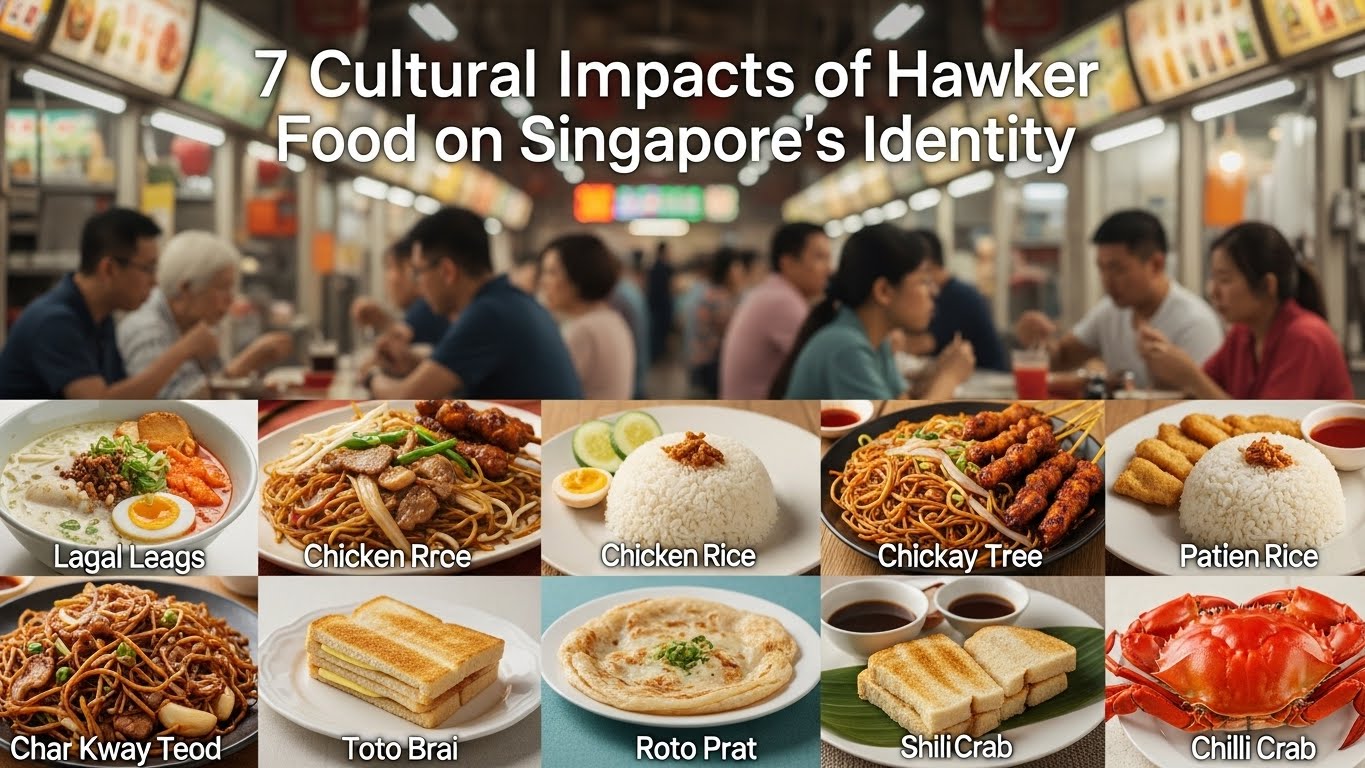
One of the most profound cultural impacts of hawker food is how it embodies Singapore’s multicultural identity. Few places in the world offer such a seamless blending of Chinese, Malay, Indian, and Peranakan cuisines in one communal space. At a single hawker centre, diners can enjoy nasi lemak, roti prata, laksa, chicken rice, satay, and bak kut teh all prepared side by side. The fusion found in local favourites mirrors what food lovers discover in Singapore cuisine food secrets.
This culinary coexistence reflects Singapore’s social fabric. Instead of maintaining separate food traditions in isolation, communities have shared, adapted, and integrated their dishes. Malay spices influenced Chinese stir-fries, Indian techniques shaped local curries, and Peranakan cuisine blended Chinese and Malay flavours into something distinctly Singaporean.
2. Preservation of Heritage and Traditional Recipes
Hawker food plays a crucial role in safeguarding Singapore’s culinary heritage. Many hawker stalls are family-run businesses that have been passed down for decades. Recipes are often guarded closely, perfected through years of repetition, and rooted in ancestral cooking methods.
In an age of globalisation and fast food, hawker centres preserve dishes that might otherwise disappear. Traditional techniques such as hand-grinding spices, slow-braising broths, or charcoal grilling remain part of daily life rather than museum exhibits. For many Singaporeans, hawker food is the most direct connection to their grandparents’ generation.
3. Social Equality and Community Life

Perhaps the most distinctive cultural impact of hawker food is how it promotes social equality. In hawker centres, everyone queues at the same stalls, shares tables, and eats the same dishes. A corporate executive may sit beside a construction worker, a student beside a retiree. In a highly structured and achievement-oriented society, hawker centres are one of the few truly egalitarian public spaces.
Meals at hawker centres are not just about convenience they are social rituals. Families gather after work, colleagues eat lunch together, and neighbours catch up over kopi and kaya toast. This daily interaction strengthens community bonds and reinforces a sense of belonging.
4. National Pride and Cultural Recognition
Hawker food has become a symbol of national pride. Dishes such as Hainanese chicken rice, chilli crab, laksa, and satay are not merely popular they are cultural icons. They appear in tourism campaigns, international food festivals, and diplomatic events, representing Singapore to the world.
The 2020 UNESCO listing further elevated hawker culture as a defining feature of national identity. For many Singaporeans, this recognition validated what they already knew: hawker food is not just cuisine; it is culture. It reflects the country’s history of migration, its emphasis on community, and its ability to transform necessity into heritage.
National pride in hawker food is also visible in local debates about preservation such as how to encourage younger generations to take up the profession, modernise facilities without losing authenticity, and balance innovation with tradition. These conversations highlight how deeply hawker culture is embedded in Singapore’s sense of self.
5. Shaping Singapores Global Food Reputation
Singapore is now regarded as one of the world’s great food capitals, and hawker food is central to that reputation. Unlike many culinary destinations defined by fine dining, Singapore’s global appeal lies in the accessibility and quality of its everyday food.
International media, food critics, and travel publications frequently celebrate hawker centres as must-visit destinations. Some hawker stalls have even earned Michelin recognition an unprecedented acknowledgment of street-level cuisine. This has challenged traditional ideas about what constitutes “high-quality” food and elevated everyday dishes to global acclaim.
Hawker Food vs Global Food Cultures
| Aspect | Singapore Hawker Culture | Fine Dining Capitals | Street Food Destinations |
|---|---|---|---|
| Accessibility | Open to all, low cost | Exclusive, expensive | Affordable but informal |
| Cultural Representation | Multicultural heritage | Elite culinary arts | Local traditions |
| Global Recognition | UNESCO + Michelin | Michelin dominance | Tourism-driven |
| Community Role | Daily social space | Occasional dining | Primarily commercial |
| Identity Impact | National symbol | Luxury branding | Regional identity |
6. Economic Identity and Small Business Culture
Beyond its cultural symbolism, hawker food also defines Singapore’s economic character. Hawker stalls are typically small, family run enterprises built on skill, reputation, and customer loyalty rather than corporate scale. They represent the entrepreneurial spirit that has long been central to Singapore’s development.
For many families, a hawker stall is both a livelihood and a legacy. Success depends on consistency, efficiency, and the ability to adapt while maintaining authenticity. This mirrors broader national values: pragmatism, hard work, and continuous improvement.
7. Cultural Education for Future Generations

Perhaps the most enduring impact of hawker food lies in its role as a cultural educator. Every meal at a hawker centre is an informal lesson in history, identity, and coexistence. Children grow up recognising dishes from different cultures as part of their own everyday life, fostering mutual respect and understanding.
Through food, younger generations learn about migration patterns, religious practices, and regional traditions without formal instruction. A plate of nasi lemak introduces Malay heritage; a bowl of laksa reflects Peranakan fusion; roti prata speaks to Indian influences. These experiences cultivate cultural literacy naturally and continuously. Such everyday exposure builds cultural literacy naturally, complementing the narratives shared in hidden food spots in Singapore
The Evolution of Hawker Culture in Singapore
Hawker culture in Singapore began with street vendors serving affordable meals to workers and migrant communities in the early 20th century. Influenced by Chinese, Malay, Indian, and Peranakan traditions, these roadside stalls became popular for their flavour and low prices. However, issues of hygiene and overcrowding led the government to reorganise hawkers into clean, regulated hawker centres from the 1960s onwards.
Today, hawker centres are more than just places to eat. They preserve traditional recipes, adapt to modern tastes, and bring people from all backgrounds together. With growing global recognition including UNESCO’s Intangible Cultural Heritage status Singapore’s hawker culture continues to evolve while remaining a core part of the nation’s everyday life and identity.
Evolution of Hawker Culture
| Period | Key Development | Cultural Significance |
|---|---|---|
| 19th–Early 20th C. | Street vendors serve migrant communities | Survival and grassroots culture |
| 1960s–1980s | Government builds formal hawker centres | Hygiene, accessibility, standardisation |
| 1990s–2000s | Culinary diversification and regional specialities | Expansion of multicultural identity |
| 2020 (UNESCO) | Hawker culture recognised as Intangible Heritage | Global validation of national culture |
| Future Era | Modernisation, digital payments, youth engagement | Sustainability of identity |
Why Hawker Food Remains Irreplaceable in Singapore
Despite globalisation, delivery apps, and changing lifestyles, hawker food remains irreplaceable. It is woven into daily routines, public spaces, and national memory. Unlike restaurant trends that come and go, hawker culture is resilient because it serves a deeper purpose it connects people to one another and to their shared past.
Hawker centres are not merely food courts; they are cultural commons. They host conversations, preserve traditions, and reflect the values of a society built on diversity and practicality. In a rapidly evolving city, they provide continuity a reminder that progress does not require abandoning identity.
Conclusion
Hawker food has shaped Singapore’s identity in ways few cultural institutions can. It integrates diverse communities, preserves heritage, promotes equality, inspires national pride, enhances global reputation, supports small businesses, and educates future generations. Through these seven cultural impacts, hawker food has become the most authentic expression of what it means to be Singaporean.
More than a collection of dishes, hawker culture represents a philosophy: that quality should be accessible, that diversity should be shared, and that everyday life can carry deep cultural meaning. As Singapore continues to evolve, hawker food remains its cultural anchor humble, enduring, and profoundly human.
FAQs
1.Why is hawker food so important to Singapores culture?
Hawker food reflects Singapore’s multicultural heritage, social equality, and community life. It is accessible to all and represents shared national values.
2.Why did UNESCO recognise Singapores hawker culture?
UNESCO recognised hawker culture for its role in preserving culinary heritage, fostering social cohesion, and representing everyday cultural practices.
3.How does hawker food promote multiculturalism?
Hawker centres bring Chinese, Malay, Indian, and Peranakan cuisines together, allowing people to experience different traditions in one communal space.
4.Is hawker food only for tourists?
No. Hawker food is primarily for locals and is part of daily life in Singapore, making it a genuine cultural institution rather than a tourist attraction.
5.What challenges does hawker culture face today?
Rising costs, labour shortages, and generational shifts threaten sustainability, but government support and cultural initiatives aim to preserve it.