








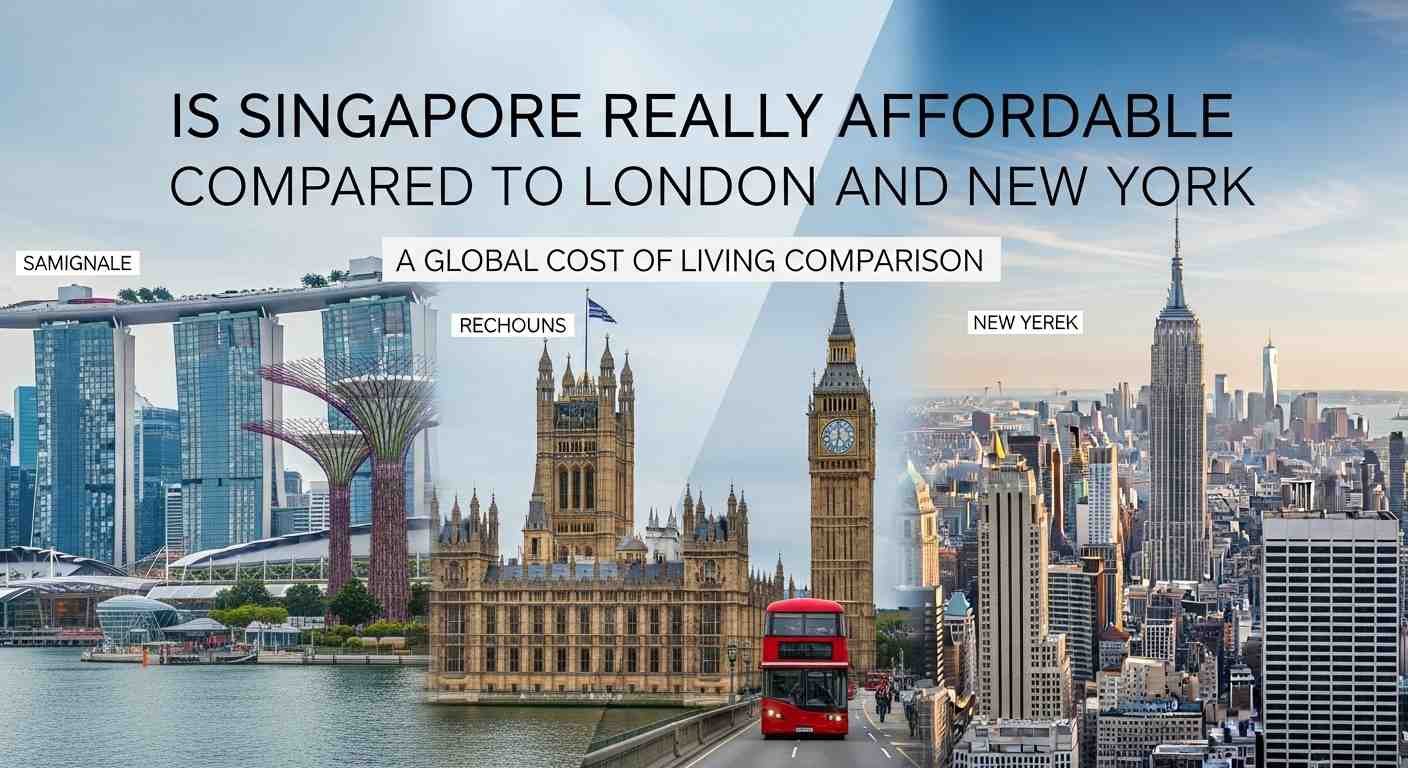
Is Singapore really affordable compared to London and New York For most professionals and couples without children, Singapore offers superior value primarily due to dramatically lower taxes (7-10% effective rate versus 28-35% in London and New York), highly efficient public transportation costing just USD 88-110 monthly compared to USD 200-300 in London or USD 132 in New York, and affordable local dining through hawker centers where meals cost USD 3-6. While housing costs are comparable across all three cities for similar quality and space, Singapore condominiums include amenities like pools, gyms, security, and maintenance that cost extra in London and New York, making the overall package more valuable despite similar headline rental prices of USD 3,300-4,800 for two-bedroom city-center apartments.
Table Of Content
- Understanding the Affordability Landscape
- Housing: The Biggest Budget Impact
- Singapore Housing Reality
- London Housing Landscape
- New York City Housing Costs
- Transportation: Getting Around the City
- Singapore’s Transportation Efficiency
- London’s Transport Network
- New York’s Transit System
- Food and Dining: Daily Sustenance Costs
- Singapore’s Food Scene
- London’s Food Landscape
- New York’s Dining Economics
- Healthcare: Medical Care and Insurance
- Singapore’s Healthcare Model
- London’s NHS System
- New York’s Private Healthcare
- Education: Schooling and Childcare Costs
- Singapore Education Costs
- London Education Landscape
- New York Education Options
- Taxation and Take-Home Pay
- Singapore Tax Structure
- London Tax System
- New York Tax Burden
- Entertainment and Lifestyle Costs
- The Verdict: Which City is Most Affordable
- Final Analysis: True Affordability Beyond Numbers
However, affordability shifts based on family situation and lifestyle choices. London becomes most cost-effective for families with children due to free quality state schools and NHS healthcare, eliminating the massive education expenses of USD 22,000-33,000 annually for Singapore’s international schools or USD 30,000-60,000 in New York’s private schools, plus healthcare insurance costs. New York consistently ranks as the most expensive city overall, with healthcare alone requiring USD 400-800 monthly for individuals or USD 1,200-2,500 for families, the highest rents averaging USD 5,000-7,500 for two-bedroom Manhattan apartments, and combined federal, state, and city taxes reaching 30-35%. This guide breaks down real costs across housing, transportation, food, healthcare, education, and taxation to determine which global city truly delivers the best value for your specific circumstances.
Understanding the Affordability Landscape
Before diving into specific cost comparisons, it’s essential to understand that “affordability” encompasses more than just expenses. It includes earning potential, tax implications, quality of services received for money spent, and overall value proposition each city offers.
Key factors influencing true affordability:
- Net income after taxes and mandatory contributions
- Housing costs relative to income and space received
- Public transportation efficiency and coverage
- Healthcare system accessibility and out-of-pocket costs
- Education quality and associated expenses
- Daily necessities and grocery costs
- Entertainment and lifestyle maintenance expenses
- Savings potential and wealth accumulation opportunities
Singapore operates on a different economic model than London or New York, with lower income taxes but higher consumption taxes and mandatory savings schemes that affect take-home pay and purchasing power differently.
Housing: The Biggest Budget Impact

Housing represents the single largest expense in all three cities, often consuming 30-50% of household income. However, what you get for your money varies dramatically.
Singapore Housing Reality
Singapore’s housing market operates on a unique dual system. About 80% of citizens live in government-subsidized HDB (Housing Development Board) flats, which are significantly more affordable but generally unavailable to expatriates. Foreigners typically rent private condominiums or landed properties at market rates.
Average monthly rent in Singapore:
- 1-bedroom apartment (city center): SGD 3,000-4,500 (USD 2,200-3,300)
- 2-bedroom apartment (city center): SGD 4,500-6,500 (USD 3,300-4,800)
- 3-bedroom apartment (city center): SGD 6,500-10,000 (USD 4,800-7,400)
- 3-bedroom apartment (suburbs): SGD 4,000-6,000 (USD 2,950-4,400)
Private condominiums typically include amenities like swimming pools, gyms, security, and maintenance, which adds value beyond just square footage.
London Housing Landscape
London’s housing market is notoriously expensive, with significant variation between zones and boroughs. The further from Zone 1 you move, the more affordable housing becomes, but commute times increase substantially.
Average monthly rent in London:
- 1-bedroom apartment (Zone 1-2): GBP 2,000-3,000 (USD 2,500-3,750)
- 2-bedroom apartment (Zone 1-2): GBP 2,800-4,500 (USD 3,500-5,600)
- 3-bedroom apartment (Zone 1-2): GBP 3,500-6,000 (USD 4,400-7,500)
- 3-bedroom apartment (Zone 3-4): GBP 2,200-3,500 (USD 2,750-4,400)
London properties rarely include amenities beyond basic fixtures, and heating costs can add GBP 150-300 monthly during winter months.
New York City Housing Costs
New York, particularly Manhattan, represents one of the world’s most expensive housing markets. Brooklyn and Queens offer more moderate pricing, but still command premium rates by global standards.
Average monthly rent in New York:
- 1-bedroom apartment (Manhattan): USD 3,500-5,000
- 2-bedroom apartment (Manhattan): USD 5,000-7,500
- 3-bedroom apartment (Manhattan): USD 7,000-12,000
- 2-bedroom apartment (Brooklyn): USD 3,500-5,500
New York apartments are typically smaller than equivalent Singapore or London units, and amenities vary widely. Broker fees (often 15% of annual rent) and security deposits add significant upfront costs.
| City | 2-Bed City Center | Space (avg sq ft) | Amenities Included | Additional Costs |
|---|---|---|---|---|
| Singapore | USD 3,300-4,800 | 900-1,100 | Pool, gym, security, maintenance | Minimal |
| London | USD 3,500-5,600 | 700-900 | Usually none | Heating, council tax (GBP 100-250/mo) |
| New York | USD 5,000-7,500 | 800-1,000 | Varies widely | Utilities, broker fees (upfront) |
Verdict on Housing: Singapore offers better value per square foot with included amenities, though absolute costs are comparable. New York is definitively the most expensive, while London falls in between but offers less space and fewer amenities.
Transportation: Getting Around the City
Transportation costs and efficiency significantly impact both affordability and quality of life. How you commute affects not just your budget but your time and stress levels.
Singapore’s Transportation Efficiency
Singapore boasts one of the world’s most efficient, affordable, and comprehensive public transportation systems. The MRT (Mass Rapid Transit) and bus network covers virtually the entire island.
Transportation costs in Singapore:
- Monthly MRT/bus pass: SGD 120-150 (USD 88-110)
- Taxi/Grab average ride (5km): SGD 10-15 (USD 7-11)
- Car ownership: Extremely expensive due to COE (Certificate of Entitlement) system
- COE costs: SGD 60,000-110,000 (USD 44,000-81,000) before vehicle price
- Monthly car expenses (including parking, insurance, fuel): SGD 1,500-2,500
Most expatriates in Singapore rely exclusively on public transportation and ride-hailing services, making it highly affordable for those willing to forgo car ownership.
London’s Transport Network
London’s extensive Underground (Tube), bus, and rail network provides good coverage, though costs are significantly higher than Singapore.
Transportation costs in London:
- Monthly Travelcard (Zones 1-2): GBP 160 (USD 200)
- Monthly Travelcard (Zones 1-4): GBP 240 (USD 300)
- Oyster pay-as-you-go daily cap (Zones 1-2): GBP 8.10
- Black cab average ride (5km): GBP 15-20 (USD 19-25)
- Car ownership: Moderate to expensive
- Congestion charge (central London): GBP 15/day (USD 19)
- Monthly parking (central): GBP 400-600 (USD 500-750)
New York’s Transit System
New York’s subway system runs 24/7 and covers extensive areas, though reliability and cleanliness issues persist. The unlimited monthly MetroCard offers good value for regular commuters.
Transportation costs in New York:
- Monthly unlimited MetroCard: USD 132
- Single subway ride: USD 2.90
- Taxi average ride (5km): USD 15-20
- Uber/Lyft average ride (5km): USD 12-18
- Car ownership: Expensive, especially parking
- Monthly parking (Manhattan): USD 400-700
- Bridge and tunnel tolls: USD 10-17 per crossing
| City | Monthly Public Transit | Single Ride | Taxi (5km) | Car Ownership Viability |
|---|---|---|---|---|
| Singapore | USD 88-110 | USD 1-2 | USD 7-11 | Prohibitively expensive |
| London | USD 200-300 | USD 3.50 | USD 19-25 | Expensive, discouraged in center |
| New York | USD 132 | USD 2.90 | USD 15-20 | Expensive, parking very costly |
Verdict on Transportation: Singapore wins decisively on affordability and efficiency for public transport users. New York offers moderate costs, while London is the most expensive for regular commuters.
Food and Dining: Daily Sustenance Costs

Food costs vary dramatically depending on whether you cook at home, eat at local establishments, or dine at international restaurants.
Singapore’s Food Scene
Singapore’s unique hawker center culture provides incredibly affordable local meals, while supermarket groceries and Western foods carry premium prices due to import dependency (Singapore imports over 90% of food).
Typical food costs in Singapore:
- Hawker center meal: SGD 4-8 (USD 3-6)
- Mid-range restaurant meal: SGD 20-40 (USD 15-30)
- Fine dining (per person): SGD 100-200+ (USD 74-148+)
- Monthly groceries (single person): SGD 300-500 (USD 220-370)
- Monthly groceries (family of 4): SGD 800-1,400 (USD 590-1,035)
- Coffee (local kopitiam): SGD 1.50-3 (USD 1.10-2.20)
- Coffee (Starbucks): SGD 6-8 (USD 4.40-5.90)
London’s Food Landscape
London offers diverse dining options at all price points, with groceries generally more affordable than Singapore, especially for European products.
Typical food costs in London:
- Pub meal or casual dining: GBP 12-20 (USD 15-25)
- Mid-range restaurant meal: GBP 25-50 (USD 31-62)
- Fine dining (per person): GBP 80-150+ (USD 100-188+)
- Monthly groceries (single person): GBP 200-350 (USD 250-437)
- Monthly groceries (family of 4): GBP 500-800 (USD 625-1,000)
- Coffee (cafe): GBP 2.50-4 (USD 3.10-5)
- Pint of beer: GBP 6-8 (USD 7.50-10)
New York’s Dining Economics
New York provides endless dining variety, though eating out is expensive. Groceries are moderately priced, though quality produce can be costly.
Typical food costs in New York:
- Casual dining meal: USD 15-25
- Mid-range restaurant meal: USD 30-60
- Fine dining (per person): USD 100-200+
- Monthly groceries (single person): USD 300-500
- Monthly groceries (family of 4): USD 800-1,300
- Coffee (deli): USD 2-3
- Coffee (Starbucks): USD 5-7
- Slice of pizza: USD 3-5
Verdict on Food: Singapore offers the best value for those embracing local cuisine and hawker centers. London and New York are comparable for groceries, but Singapore’s local dining options provide unmatched affordability for everyday meals.
Healthcare: Medical Care and Insurance

Healthcare systems and costs differ fundamentally across these three cities, significantly impacting overall affordability.
Singapore’s Healthcare Model
Singapore’s healthcare system combines public subsidies with mandatory savings (Medisave) and private insurance. It’s highly efficient but requires understanding the system.
Healthcare costs in Singapore:
- Public hospital ward (subsidized): SGD 50-150/day
- Private hospital room: SGD 300-800/day
- GP consultation: SGD 20-60
- Specialist consultation: SGD 80-200
- Private health insurance: SGD 200-600/month (USD 148-444)
- Dental cleaning: SGD 80-150
Expats typically require private health insurance as they don’t access the same subsidies as citizens.
London’s NHS System
The UK’s National Health Service (NHS) provides free healthcare to residents, though private options exist for faster access.
Healthcare costs in London:
- NHS services: Free for residents (funded through taxes)
- GP consultation: Free
- Hospital treatment: Free
- Private GP consultation: GBP 80-150 (USD 100-188)
- Private health insurance: GBP 100-300/month (USD 125-375)
- Dental (private): GBP 50-120 for checkup
The NHS represents significant value, though wait times can be long for non-emergency procedures.
New York’s Private Healthcare
The US healthcare system is primarily private and insurance-based, with significantly higher costs than Singapore or London.
Healthcare costs in New York:
- Health insurance premium (individual): USD 400-800/month
- Health insurance (family): USD 1,200-2,500/month
- Doctor visit copay: USD 25-75
- Specialist copay: USD 50-150
- Emergency room visit: USD 500-3,000+ (before insurance)
- Dental cleaning: USD 100-200
Even with insurance, out-of-pocket costs can be substantial, making healthcare a major budget consideration.
Verdict on Healthcare: London wins for those accessing NHS services. Singapore offers good value with efficient private care at moderate costs. New York’s healthcare is prohibitively expensive, even with insurance.
Education: Schooling and Childcare Costs
For families with children, education costs significantly impact affordability calculations.
Singapore Education Costs
Singapore’s education system is world-class, but international schools (which most expat children attend) are very expensive.
Education costs in Singapore:
- International school (primary): SGD 25,000-35,000/year (USD 18,500-25,900)
- International school (secondary): SGD 30,000-45,000/year (USD 22,200-33,300)
- Childcare/preschool: SGD 1,000-2,500/month (USD 740-1,850)
- Local school (if eligible): Minimal costs
London Education Landscape
London offers free state schools with generally good quality, though many expats choose private education.
Education costs in London:
- State school: Free
- Private day school: GBP 15,000-25,000/year (USD 18,750-31,250)
- Top private schools: GBP 25,000-45,000/year (USD 31,250-56,250)
- Nursery/childcare: GBP 1,200-2,000/month (USD 1,500-2,500)
New York Education Options
New York public schools vary widely in quality by neighborhood, with many families choosing private education.
Education costs in New York:
- Public school: Free
- Private day school: USD 30,000-50,000/year
- Elite private schools: USD 50,000-60,000/year
- Preschool/daycare: USD 1,500-3,000/month
| City | International/Private School (Annual) | Public/State School | Childcare (Monthly) | Overall Value |
|---|---|---|---|---|
| Singapore | USD 22,000-33,000 | Not readily accessible | USD 740-1,850 | Expensive for expats |
| London | USD 18,750-56,250 | Free, good quality | USD 1,500-2,500 | Best if using state schools |
| New York | USD 30,000-60,000 | Free, quality varies | USD 1,500-3,000 | Most expensive private |
Verdict on Education: London offers the best value for families accessing quality state schools. Singapore and New York both have expensive private/international school options, with New York being slightly more costly.
Taxation and Take-Home Pay
Understanding net income after taxes is crucial for true affordability comparisons.
Singapore Tax Structure
Singapore has one of the world’s most favorable personal tax systems, with progressive rates topping out at 22% (for income above SGD 500,000).
Singapore tax highlights:
- Low personal income tax rates (0-22%)
- No capital gains tax
- Mandatory CPF contributions (20% employee, 17% employer for citizens; not applicable to most expats)
- GST (consumption tax): 9%
- Estimated effective tax rate (USD 100k income): ~7-10%
London Tax System
The UK has higher personal taxes but includes NHS funding and other social benefits.
London tax highlights:
- Personal income tax: 20-45%
- National Insurance: 12-2%
- Council tax: GBP 100-250/month
- VAT: 20% on most goods
- Estimated effective tax rate (USD 100k income): ~28-32%
New York Tax Burden
New York residents face federal, state, and city income taxes, creating one of the highest tax burdens in the US.
New York tax highlights:
- Federal income tax: 10-37%
- New York State tax: 4-10.9%
- New York City tax: 3.078-3.876%
- Social Security/Medicare: 7.65%
- Sales tax: ~8.875%
- Estimated effective tax rate (USD 100k income): ~30-35%
Verdict on Taxation: Singapore’s low tax environment significantly increases take-home pay, providing major advantage in accumulating wealth. London and New York have comparable high-tax environments.
Entertainment and Lifestyle Costs
Quality of life includes leisure activities, which vary considerably in cost.
Entertainment comparison:
- Cinema ticket: Singapore USD 10, London USD 16, New York USD 18
- Gym membership: Singapore USD 100-150/mo, London USD 60-100/mo, New York USD 100-200/mo
- Theater/show: Singapore USD 50-150, London USD 40-120, New York USD 80-200
- Monthly utilities (1-bed): Singapore USD 100-150, London USD 150-250, New York USD 120-180
- Internet: Singapore USD 30-50, London USD 35-50, New York USD 50-80
Singapore and New York are comparable for entertainment, while London offers moderate pricing for cultural activities.
The Verdict: Which City is Most Affordable
The answer depends entirely on your circumstances:
Singapore is most affordable for:
- Single professionals or couples without children
- Those embracing local lifestyle (hawker food, public transport)
- High earners benefiting from low taxes
- Those valuing efficient services and included amenities
London is most affordable for:
- Families with school-age children (state schools)
- Those prioritizing free healthcare
- People comfortable with longer commutes for cheaper housing
- Those who don’t mind higher taxation for social services
New York is least affordable overall for:
- Almost everyone, particularly families
- Healthcare costs create significant burden
- Education is most expensive
- However, earning potential in certain industries may compensate
Final Analysis: True Affordability Beyond Numbers
Pure cost comparisons tell only part of the story. Singapore’s compact size means shorter commutes, saving time and stress. London’s cultural richness and European accessibility add intangible value. New York’s career opportunities in finance, media, and arts may justify higher costs for some.
Consider these additional factors:
- Savings potential: Singapore’s low taxes enable faster wealth accumulation
- Climate: Singapore’s tropical climate eliminates heating costs but increases air conditioning expenses
- Safety: Singapore’s extremely low crime rate may reduce insurance and security costs
- Work-life balance: Commute times and work culture significantly impact quality of life
- Long-term wealth: Property appreciation potential differs substantially
For most expatriates and professionals, Singapore offers better overall value than London or New York when considering the complete package: lower taxes, efficient public services, included condo amenities, affordable local dining, and excellent public transport create a lifestyle that’s sustainable at lower gross income levels than comparable quality of life in London or New York.
However, families with multiple school-age children may find London more affordable due to quality state schools, while certain high earners in specialized New York industries might justify that city’s premium costs through superior compensation packages.
The key to affordability in any of these cities is understanding which costs you can control (housing location, dining choices, transport mode) versus fixed costs (healthcare, education, taxes), then making strategic lifestyle choices that align with your financial priorities and personal values.


No Comment! Be the first one.