








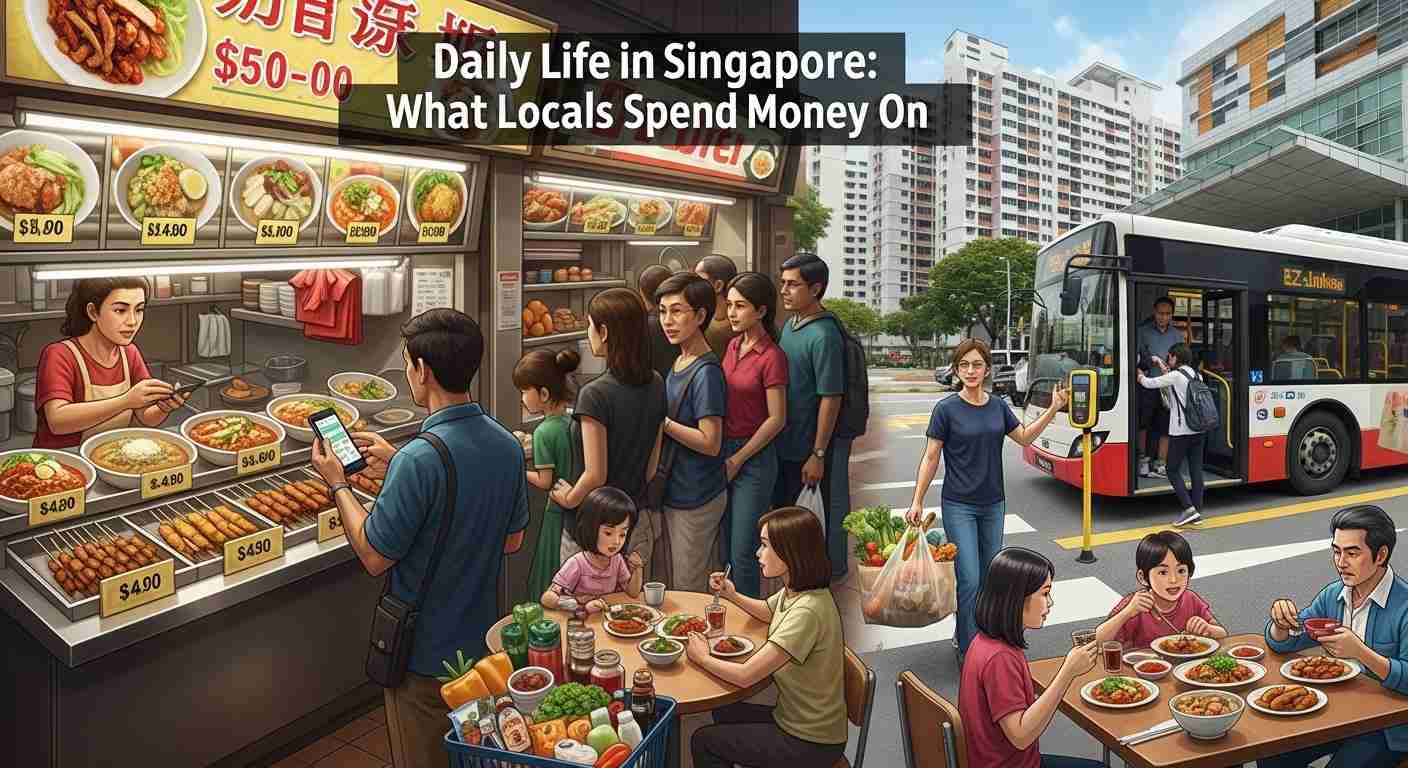
Daily life in Singapore centers around efficient public transport, diverse food culture, and high living costs in a tropical city-state where 80% of residents live in HDB public housing flats. The average Singaporean commutes via MRT (SGD 100-150 monthly), works 9 AM-6 PM earning a median salary of SGD 5,070, and spends approximately SGD 4,906 monthly on housing (SGD 1,500-2,800), food from hawker centers (SGD 3.50-6 per meal) and restaurants, utilities (SGD 150-250), and transportation. Daily routines include breakfast at kopitiams for SGD 3-5, lunch at one of 114 hawker centers, and evenings at shopping malls or parks, navigating strict laws where littering fines start at SGD 300 and chewing gum remains banned.
A typical day involves multilingual interactions across English, Mandarin, Malay, and Tamil in a meritocratic society that prioritizes education spending (SGD 200-800 monthly per child for tuition) and food as cultural bonding, with families dedicating 15-20% of budgets to dining. Weekends feature visits to Gardens by the Bay, Sentosa, East Coast Park, or Orchard Road shopping districts, while the tropical climate (27-31°C year-round) keeps most activities indoors or in air-conditioned spaces. About 40% of households own cars despite high costs (SGD 150,000-180,000 including COE), with most relying on world-class public transport, creating a unique urban lifestyle balancing Asian values with cosmopolitan efficiency in one of the world’s most expensive yet livable cities.
Table Of Content
- The Singapore Cost of Living Landscape
- Housing: The Biggest Monthly Expense
- HDB Flat Ownership and Costs
- Private Property and Rental Markets
- Food and Dining: A Cultural Priority
- Hawker Centers and Coffee Shops
- Restaurants and Food Delivery
- Groceries and Home Cooking
- Transportation: Efficiency Comes at a Cost
- Public Transportation
- Grab and Taxis
- Car Ownership
- Monthly Household Expenditure Breakdown
- Education: Investment in the Future
- Primary and Secondary Education
- Tertiary Education
- Healthcare and Wellness Spending
- Routine Healthcare
- Health Insurance and Wellness
- Utilities and Essential Services
- Electricity and Water
- Telecommunications
- Streaming and Subscriptions
- Entertainment and Lifestyle Spending
- Dining Out and Social Activities
- Shopping and Personal Care
- Travel and Holidays
- Age and Life Stage Spending Patterns
- Domestic Help and Childcare Costs
- Foreign Domestic Workers
- Childcare and Preschool
- Saving and Investment Habits
- Regular Savings
- Investment Activities
- The Role of Government Support and Subsidies
- Conclusion
The Singapore Cost of Living Landscape
Singapore consistently ranks as one of the world’s most expensive cities, yet it also boasts one of the highest standards of living in Asia. The average Singaporean household spends approximately SGD 4,906 per month according to recent household expenditure surveys, though this varies significantly based on household size, income level, and lifestyle choices.
What makes Singapore’s spending patterns particularly interesting is the mandatory savings system through the Central Provident Fund (CPF), which requires both employers and employees to contribute a percentage of monthly salary. This system fundamentally shapes how Singaporeans approach spending, saving, and investment, creating unique financial behaviors not seen in many other developed nations.
The cost of living in Singapore reflects its position as a global financial hub with limited land and resources. Nearly everything except some local food items comes with a premium price tag. However, Singaporeans have adapted their spending habits to balance quality of life with financial prudence, creating a distinctive consumer culture that values both practicality and occasional indulgence.
Housing: The Biggest Monthly Expense

For most Singaporean families, housing represents the single largest expenditure category, typically consuming 25-35% of monthly household income. The housing landscape in Singapore is dominated by Housing Development Board (HDB) flats, public housing that approximately 80% of the population calls home.
HDB Flat Ownership and Costs
The average HDB flat owner pays between SGD 1,200 to SGD 2,500 monthly for their mortgage, depending on flat type, location, and remaining loan tenure. A 4-room HDB flat in a mature estate like Ang Mo Kio or Tampines might cost around SGD 450,000 to SGD 550,000, translating to monthly mortgage payments of approximately SGD 1,800 to SGD 2,200 over a 25-year loan period.
What’s unique about HDB financing is that Singaporeans primarily use their CPF Ordinary Account to service housing loans, meaning many homeowners don’t feel the direct cash flow impact of mortgage payments. However, this still represents a significant portion of their earnings being channeled toward housing.
Private Property and Rental Markets
For those living in private condominiums, monthly costs escalate considerably. Mortgage payments for a modest 3-bedroom condominium can range from SGD 3,500 to SGD 6,000 monthly, depending on location and property age. Prime districts like Orchard, Marina Bay, or Sentosa Cove command even higher prices.
Renters face substantial expenses too. A room in an HDB flat costs SGD 600 to SGD 1,200 monthly, while renting an entire HDB flat ranges from SGD 2,000 to SGD 3,500. Private condominium rentals start at SGD 2,800 for smaller units and can exceed SGD 8,000 for family-sized apartments in desirable locations.
Beyond mortgage or rent, Singaporeans budget for property tax, maintenance fees, utilities, and home insurance. Condominium maintenance fees typically range from SGD 200 to SGD 800 monthly depending on facilities and development size.
Food and Dining: A Cultural Priority
Food holds a special place in Singaporean culture, and spending patterns reflect this passion. The average household spends SGD 800 to SGD 1,200 monthly on food, representing roughly 15-20% of total expenditure.
Hawker Centers and Coffee Shops
The backbone of affordable dining in Singapore is the extensive hawker center network. A typical hawker meal costs SGD 3.50 to SGD 6, making it possible for a person to eat three meals daily for approximately SGD 12 to SGD 18. Many working Singaporeans eat at hawker centers for lunch, spending around SGD 5 to SGD 8 per meal.
Coffee shop culture is equally ingrained in daily life. The morning kopi (coffee) routine costs SGD 1.20 to SGD 2.50, while kaya toast breakfast sets range from SGD 3 to SGD 5. For someone who eats breakfast out daily, this adds up to SGD 90 to SGD 150 monthly.
Restaurants and Food Delivery
Weekend dining at casual restaurants typically costs SGD 15 to SGD 35 per person, while mid-range restaurants charge SGD 30 to SGD 60 per head. Fine dining experiences can easily exceed SGD 100 to SGD 300 per person.
Food delivery has exploded in popularity, with platforms like GrabFood, Foodpanda, and Deliveroo becoming daily conveniences. Regular users spend SGD 200 to SGD 400 monthly on food delivery, paying premiums of 20-40% over dine-in prices when factoring in delivery fees and service charges.
Groceries and Home Cooking
For those who cook at home, monthly grocery bills range from SGD 300 to SGD 600 for a family of four. Supermarkets like FairPrice, Cold Storage, and Sheng Siong offer varying price points, while specialty stores like Jason’s Market Place or Marketplace cater to premium preferences with correspondingly higher prices.
Wet markets remain popular for fresh produce, meats, and seafood, often offering better value than supermarkets. A household that shops strategically between wet markets and supermarkets can reduce grocery costs by 15-25% compared to exclusive supermarket shopping.
Transportation: Efficiency Comes at a Cost

Singapore’s world-class public transportation system coexists with one of the world’s most expensive car ownership structures, creating a clear divide in transportation spending among locals.
Public Transportation
The majority of Singaporeans rely on the MRT (Mass Rapid Transit) and public buses for daily commuting. Monthly public transport expenses range from SGD 100 to SGD 150 for regular commuters. Students and seniors enjoy concessionary fares, spending approximately SGD 40 to SGD 80 monthly.
The distance-based fare system means shorter commutes cost less, with typical single journeys ranging from SGD 0.92 to SGD 2.50. Many workers purchase monthly concession passes or use stored value cards with transfer rebates to optimize costs.
Grab and Taxis
For convenience and time savings, many Singaporeans supplement public transport with private hire vehicles like Grab or traditional taxis. Regular users of ride-hailing services spend SGD 150 to SGD 300 monthly, often for late-night commutes, trips with heavy items, or travel to areas poorly served by public transport.
A typical Grab ride across the island might cost SGD 15 to SGD 30 during non-peak hours, escalating to SGD 25 to SGD 45 during peak periods or bad weather when surge pricing applies.
Car Ownership
Owning a car in Singapore is extraordinarily expensive due to the Certificate of Entitlement (COE) system, which limits vehicle population growth. The current cost of a COE for a standard car ranges from SGD 80,000 to SGD 110,000, valid for 10 years.
A modest family car like a Toyota Corolla Altis costs approximately SGD 150,000 to SGD 180,000 upfront, including COE. Monthly car ownership expenses include:
- Car loan payment: SGD 1,200 to SGD 1,800
- Petrol: SGD 200 to SGD 350
- Insurance: SGD 100 to SGD 200
- Road tax: SGD 60 to SGD 150
- Parking: SGD 150 to SGD 300
- Maintenance: SGD 80 to SGD 150
This totals SGD 1,790 to SGD 2,950 monthly, explaining why only about 40% of households own cars despite Singapore’s relative affluence.
Monthly Household Expenditure Breakdown
Understanding the complete picture of Singaporean spending requires examining all major categories. Here’s a comprehensive breakdown of average monthly household expenditure:
| Expense Category | Average Monthly Spending (SGD) | Percentage of Total Budget | Notes |
|---|---|---|---|
| Housing (Mortgage/Rent) | 1,500 – 2,800 | 30-35% | Varies by property type and location |
| Food & Dining | 800 – 1,200 | 15-20% | Includes groceries, hawker meals, restaurants |
| Transportation | 250 – 450 (no car) / 1,800 – 3,000 (with car) | 8-12% / 35-40% | Dramatic difference with car ownership |
| Utilities & Services | 150 – 250 | 3-5% | Electricity, water, internet, mobile |
| Healthcare | 150 – 300 | 3-6% | After Medisave/insurance coverage |
| Education | 200 – 800 | 4-12% | Tuition, enrichment classes, materials |
| Entertainment & Recreation | 200 – 400 | 4-8% | Movies, outings, hobbies |
| Shopping & Personal Care | 300 – 600 | 6-10% | Clothing, grooming, household items |
| Insurance & Savings | 400 – 800 | 8-15% | Beyond CPF contributions |
| Others | 150 – 300 | 3-5% | Miscellaneous expenses |
| Total (without car) | 4,100 – 6,900 | 100% | Typical middle-income household |
| Total (with car) | 5,650 – 9,150 | 100% | Car ownership significantly increases budget |
This table illustrates how car ownership fundamentally reshapes a household budget, often requiring significantly higher income or sacrifices in other categories.
Education: Investment in the Future

Education spending is a significant priority for Singaporean families, reflecting the cultural emphasis on academic achievement and the belief that education is the pathway to success.
Primary and Secondary Education
While government schools charge relatively modest fees of SGD 5 to SGD 25 monthly for Singapore citizens, the real education costs come from supplementary activities. Tuition has become almost ubiquitous, with approximately 70% of students attending additional classes.
Primary school tuition costs range from SGD 200 to SGD 400 monthly per subject, while secondary school tuition increases to SGD 250 to SGD 500 monthly. Many students take tuition for multiple subjects, creating monthly education bills of SGD 600 to SGD 1,500 or more.
Enrichment classes for music, art, sports, and languages add another layer of expense. Piano lessons cost SGD 150 to SGD 300 monthly, while swimming classes range from SGD 80 to SGD 150 monthly. Families with multiple children in various enrichment programs can easily spend SGD 800 to SGD 2,000 monthly on education beyond school fees.
Tertiary Education
University education represents a major financial commitment. Local universities charge Singapore citizens approximately SGD 8,000 to SGD 12,000 annually for tuition, typically financed through CPF Education loans or government study loans with favorable terms.
Private universities and overseas education cost significantly more, with annual tuition ranging from SGD 20,000 to SGD 50,000 or higher, not including living expenses. Many families begin saving for university education when children are born, setting aside SGD 200 to SGD 500 monthly in education savings plans.
Healthcare and Wellness Spending
Singapore’s healthcare system combines government subsidies with personal responsibility, creating a tiered structure where spending varies based on choices and needs.
Routine Healthcare
Most Singaporeans use their Medisave (a CPF component) for routine healthcare, meaning cash outlay is minimal for basic medical needs. A general practitioner visit at a polyclinic costs SGD 10 to SGD 30 after subsidies, while private clinic consultations range from SGD 30 to SGD 80.
Dental care requires more direct spending since routine dental work isn’t covered by Medisave. Regular dental check-ups cost SGD 50 to SGD 100, while fillings range from SGD 80 to SGD 200. Families typically budget SGD 50 to SGD 150 monthly for routine healthcare needs.
Health Insurance and Wellness
Beyond the basic government MediShield Life coverage, many Singaporeans purchase Integrated Shield Plans offering private hospital coverage, costing SGD 100 to SGD 300 monthly depending on age and coverage level. Critical illness insurance adds another SGD 50 to SGD 150 monthly.
Fitness and wellness spending has grown significantly. Gym memberships range from SGD 80 to SGD 200 monthly, while boutique fitness studios charge SGD 150 to SGD 400 monthly. Health-conscious Singaporeans also spend on supplements, organic foods, and wellness services, adding SGD 100 to SGD 300 monthly to household budgets.
Utilities and Essential Services
While Singapore’s utility costs are reasonable compared to many developed nations, they still represent a consistent monthly expense requiring careful management.
Electricity and Water
The average household electricity bill ranges from SGD 80 to SGD 200 monthly, heavily influenced by air conditioning usage. A 4-room HDB flat with moderate air-conditioning use typically pays SGD 120 to SGD 160 monthly.
Water bills are relatively modest, averaging SGD 30 to SGD 60 monthly for most households. The government’s tiered pricing structure encourages conservation, with higher rates for excessive consumption.
Telecommunications
Mobile phone plans range from SGD 20 for basic SIM-only plans to SGD 80 for premium unlimited data plans. Most Singaporeans spend SGD 25 to SGD 50 monthly on mobile services.
Home internet, essential for work-from-home arrangements and entertainment, costs SGD 39 to SGD 89 monthly for fiber broadband with speeds from 500 Mbps to 2 Gbps. Many households bundle services, spending SGD 60 to SGD 120 monthly on combined internet, mobile, and streaming subscriptions.
Streaming and Subscriptions
The subscription economy has taken hold in Singapore. Netflix costs SGD 13.98 to SGD 21.98 monthly, while Disney+ is SGD 11.98 monthly. Spotify Premium costs SGD 9.98 monthly. Combined with cloud storage, news subscriptions, and other digital services, households often spend SGD 50 to SGD 100 monthly on various subscriptions.
Entertainment and Lifestyle Spending
Despite the high cost of living, Singaporeans make room in their budgets for entertainment and leisure activities that enrich daily life.
Dining Out and Social Activities
Beyond regular meals, Singaporeans budget for social dining and entertainment. A typical evening out with drinks costs SGD 80 to SGD 150 per person in popular areas like Clarke Quay or Marina Bay. Weekend brunch at trendy cafes ranges from SGD 20 to SGD 40 per person.
Movie tickets cost SGD 9 to SGD 18 depending on timing and cinema, with premium formats like IMAX or Gold Class costing SGD 20 to SGD 50. Regular moviegoers spend SGD 40 to SGD 80 monthly on cinema entertainment.
Shopping and Personal Care
Clothing and fashion spending varies widely based on personal style and preferences. Budget-conscious shoppers spend SGD 100 to SGD 200 monthly, while fashion enthusiasts might allocate SGD 300 to SGD 800 or more.
Personal grooming is important in image-conscious Singapore. Haircuts cost SGD 15 to SGD 80 depending on salon tier, while manicures range from SGD 30 to SGD 80. Skincare and cosmetics add another SGD 80 to SGD 200 monthly for many individuals.
Travel and Holidays
Singaporeans are enthusiastic travelers, with many taking multiple trips annually. Budget allocations for travel vary significantly, but many households set aside SGD 300 to SGD 500 monthly toward vacation funds. A typical regional holiday to Malaysia, Thailand, or Indonesia costs SGD 1,500 to SGD 3,000 per person, while long-haul trips to Europe or the US can exceed SGD 5,000 to SGD 8,000 per person.
Age and Life Stage Spending Patterns
Spending patterns shift dramatically across different life stages, reflecting changing priorities and responsibilities:
| Life Stage | Primary Spending Focus | Monthly Budget Range | Key Characteristics |
|---|---|---|---|
| Young Singles (21-30) | Rent, food, entertainment, travel | SGD 2,000 – 3,500 | Higher discretionary spending, dining out, experiences |
| Young Couples (25-35) | Housing downpayment savings, wedding | SGD 3,500 – 5,500 | Balancing lifestyle with major savings goals |
| Young Families (30-45) | Mortgage, childcare, education | SGD 5,000 – 8,000 | Highest financial pressure period, reduced discretionary spending |
| Established Families (40-55) | Education, enrichment, career development | SGD 6,000 – 10,000 | Peak earning years, substantial education spending |
| Empty Nesters (55-65) | Healthcare, travel, retirement savings | SGD 4,000 – 7,000 | Reduced housing costs, increased health and leisure spending |
| Retirees (65+) | Healthcare, leisure, daily essentials | SGD 2,500 – 4,500 | Living on savings and CPF, healthcare becomes priority |
This lifecycle perspective reveals how financial priorities evolve, with young families facing the greatest financial stress while juggling housing, childcare, and education expenses simultaneously.
Domestic Help and Childcare Costs
For dual-income families with young children, domestic help and childcare represent significant monthly expenses that warrant separate discussion.
Foreign Domestic Workers
Approximately 1 in 5 Singaporean households employs a foreign domestic worker (maid). The monthly costs include:
- Maid salary: SGD 500 to SGD 700
- Levy: SGD 265 to SGD 450 (depending on concession eligibility)
- Food and essentials: SGD 150 to SGD 250
- Medical and insurance: SGD 30 to SGD 60
- Total monthly cost: SGD 945 to SGD 1,460
Many families find this more economical than formal childcare while providing additional household management support.
Childcare and Preschool
For families using childcare centers, monthly fees vary based on subsidy eligibility. Full-day infant care costs SGD 800 to SGD 2,000 monthly after subsidies, while preschool ranges from SGD 300 to SGD 1,500 monthly.
Private preschools and international programs charge significantly more, from SGD 1,500 to SGD 3,500 monthly, creating substantial expenses for families with multiple young children.
Saving and Investment Habits
Beyond mandatory CPF contributions (which range from 20% to 37% of gross salary depending on age), many Singaporeans practice additional saving and investing.
Regular Savings
Financial advisors recommend saving at least 20% of take-home income beyond CPF. Middle-income Singaporeans typically save SGD 500 to SGD 1,500 monthly in various instruments including regular savings accounts, fixed deposits, and money market funds.
Investment Activities
An increasing number of Singaporeans actively invest in stocks, ETFs, REITs, and unit trusts. Regular investors allocate SGD 300 to SGD 1,000 monthly through dollar-cost averaging strategies. Robo-advisors have made investing more accessible, with minimum monthly contributions starting from SGD 100.
Cryptocurrency investment has also gained traction, though it represents a smaller portion of portfolios for most investors, typically SGD 100 to SGD 500 monthly for those who participate.
The Role of Government Support and Subsidies
It’s important to note that various government schemes significantly impact actual out-of-pocket expenses for Singaporeans. The government provides substantial subsidies for housing, healthcare, education, and utility costs, particularly for lower and middle-income households.
Programs like the Workfare Income Supplement, GST Vouchers, U-Save rebates for utilities, CDC vouchers, and various targeted assistance schemes reduce the effective cost of living for many families. These subsidies can represent savings of SGD 200 to SGD 800 monthly for eligible households.
Conclusion
Daily life in Singapore reflects a careful balance between maintaining a high quality of life and managing one of the world’s highest costs of living. Singaporeans demonstrate remarkable financial discipline, with mandatory CPF savings ensuring long-term security while households navigate substantial expenses in housing, food, education, and transportation.
The spending patterns reveal cultural priorities: the premium placed on education, the central role of food in social life, the pragmatic approach to transportation with most forgoing car ownership, and the emphasis on both saving for the future and enjoying the present through travel and entertainment.
What emerges is a portrait of a society that has adapted to economic realities without sacrificing quality of life. From the affordable hawker centers that democratize good food to the world-class public transportation that reduces the need for expensive car ownership, Singapore has created infrastructure that helps residents manage costs while maintaining high standards.
For those considering moving to Singapore or simply curious about life in the city-state, understanding these spending patterns provides crucial insights into daily realities. The high costs are undeniable, but they come with corresponding benefits: safety, cleanliness, efficiency, excellent education and healthcare systems, and a cosmopolitan lifestyle that few cities can match. Singaporeans have learned to navigate this expensive landscape through smart choices, leveraging subsidies, and prioritizing what truly matters in their daily lives.

No Comment! Be the first one.