

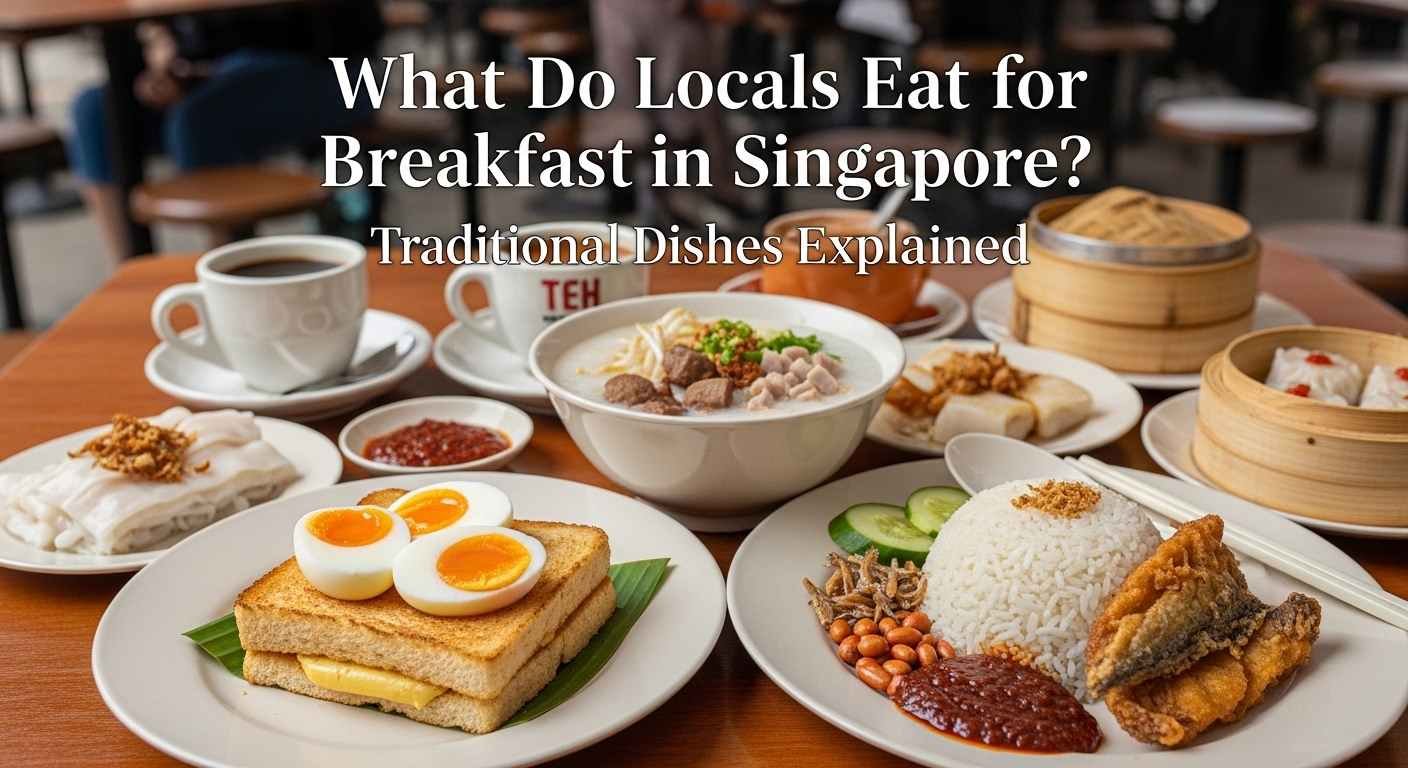
Breakfast in Singapore is a vibrant, multicultural experience rooted in the island’s rich Chinese, Malay, Indian, and Peranakan heritage. Locals start their mornings at bustling hawker centres and traditional kopitiams, where freshly made dishes like kaya toast with soft-boiled eggs, fragrant nasi lemak wrapped in banana leaf, and crispy roti prata served with curry are enjoyed daily. These spots open as early as 6am, offering hot, affordable meals that cost as little as SGD $2 making world-class breakfast accessible to everyone.
What makes breakfast in Singapore truly unique is the sheer variety available under one roof. You can slurp silky fish porridge beside someone dipping roti prata into dal curry, while another table shares a dim sum spread over pots of Chinese tea. From the iconic kopi (local charcoal-roasted coffee) to spicy mee siam noodles and delicate tau huay tofu pudding, Singapore’s breakfast culture was recognized by UNESCO in 2020 as an Intangible Cultural Heritage a testament to how deeply food is woven into the city’s everyday life and identity.
The Heartbeat of Singapore Mornings: The Kopitiam
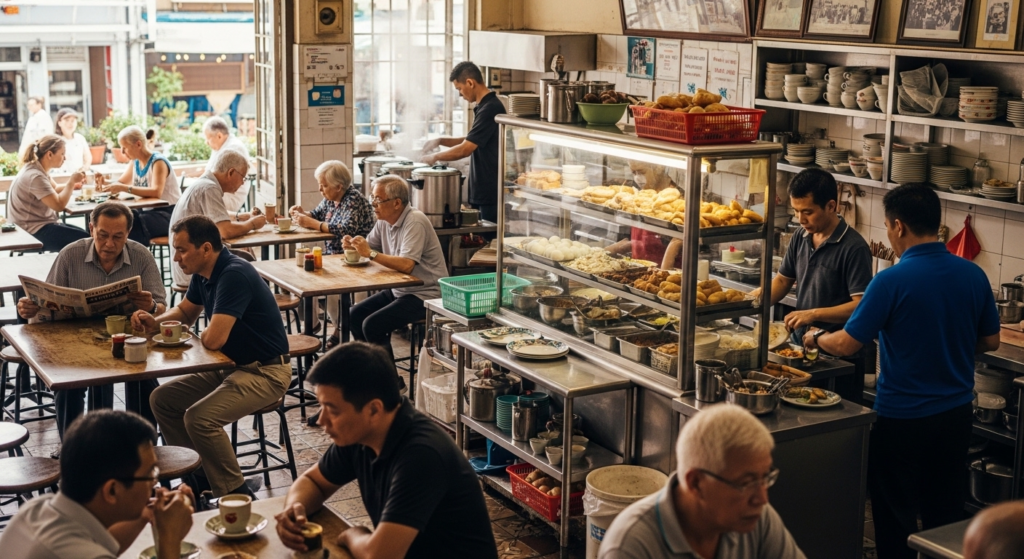
Before diving into specific dishes, it’s important to understand where Singaporean breakfast happens. The kopitiam is a traditional coffeeshop, a semi-open-air space lined with marble-top tables, plastic stools, and individual food stalls offering different specialties. These stalls are run by different hawkers, and the kopitiam owner typically manages beverages primarily the legendary kopi (local coffee) and teh (tea).
Larger, government-managed hawker centres like those at Maxwell Food Centre, Tiong Bahru Market, or Old Airport Road Food Centre are also morning hotspots. Breakfast here is cheap, incredibly flavorful, and eaten shoulder-to-shoulder with strangers which is entirely the point.
The Classic Kaya Toast Set
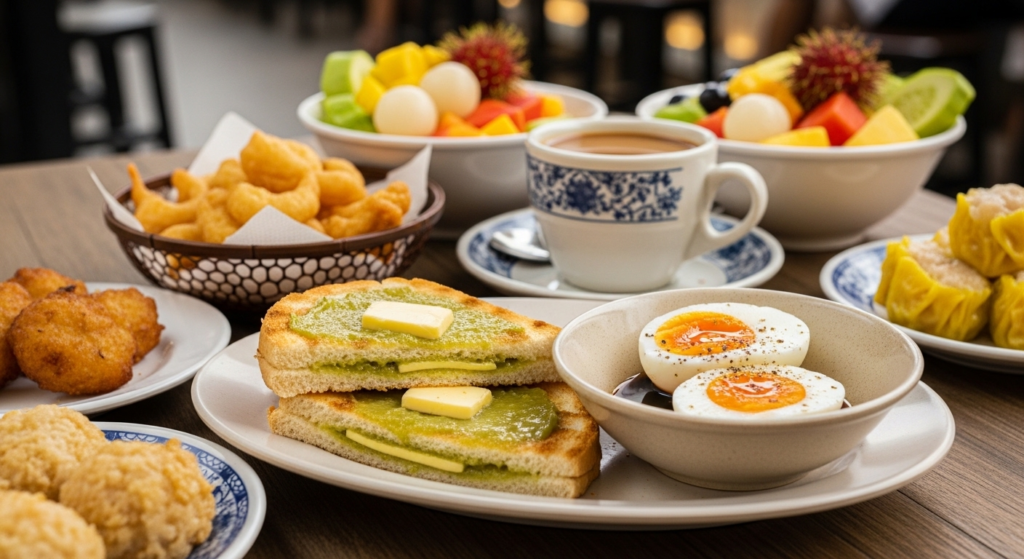
Ask any Singaporean what they eat for breakfast and kaya toast will almost certainly come up first. This deceptively simple set consists of crispy or soft-steamed bread slathered with kaya (a thick coconut-egg jam) and a pat of cold butter, served alongside two soft-boiled eggs and a cup of kopi or teh.
The bread is typically made in a charcoal-grilled or toaster oven style, giving it a light char and crunch. The kaya itself is made from coconut milk, eggs, sugar, and pandan leaves giving it a vivid green hue and a floral, creamy sweetness. The soft-boiled eggs are broken into a small dish, seasoned with soy sauce and white pepper, and the ritual involves either sipping them directly from the dish or using the toast to dip in.
Famous chains like Ya Kun Kaya Toast and Killiney Kopitiam have made this breakfast internationally recognizable, but old-school family-run kopitiams still serve the most authentic versions. If you’re planning to visit one of the most famous centres, our guide to Old Airport Road Food Centre highlights what locals actually queue for.
What Makes Kopi Different from Regular Coffee
Singaporean kopi is not your Starbucks order. It is made from Robusta coffee beans that are roasted with butter and sugar, giving the brew a heavy, slightly caramelized flavor. Here’s a quick guide to ordering:
| Order Term | What You Get |
|---|---|
| Kopi | Hot coffee with condensed milk |
| Kopi-O | Hot black coffee with sugar |
| Kopi-C | Hot coffee with evaporated milk and sugar |
| Kopi Peng | Iced coffee with condensed milk |
| Teh Tarik | Pulled milk tea, frothy and sweet |
| Milo Dinosaur | Iced Milo with extra Milo powder on top |
Ordering kopi in Singapore is essentially its own language, and locals speak it fluently every single morning.
Congee and Rice Porridge (Bubur / Porridge)
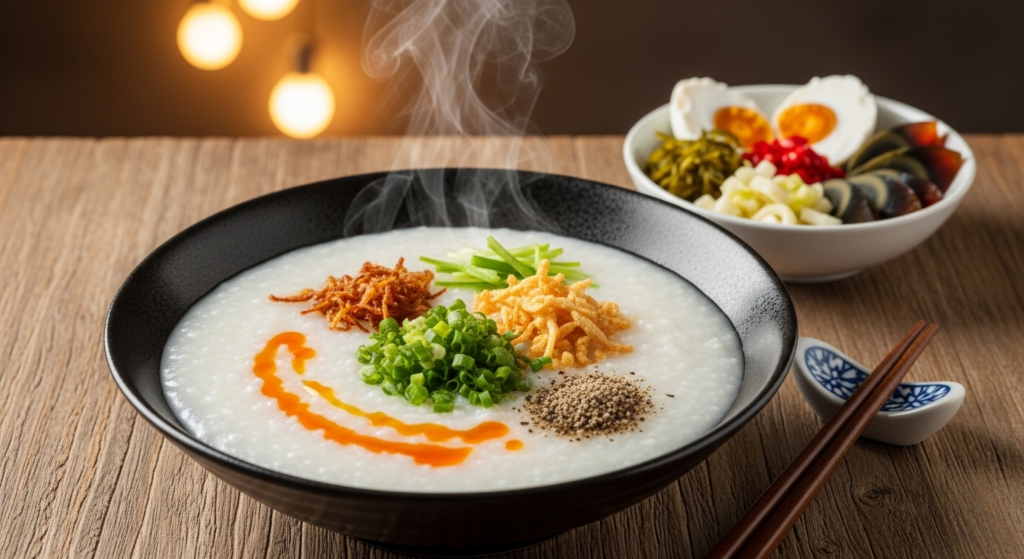
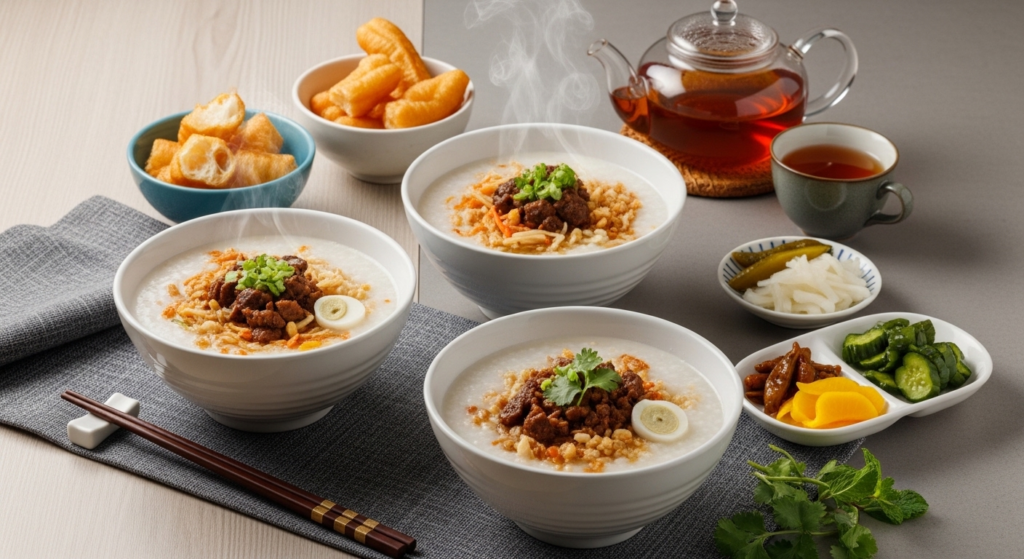
Rice porridge is one of the most comforting and widespread breakfast options across Singapore’s Chinese community. Known locally as congee or porridge, it is a slow-cooked, silky rice gruel served warm with an array of toppings. The base is mild and neutral, which makes it a perfect canvas for bold accompaniments.
Common toppings include:
- Century egg (pidan) — a preserved egg with a dark, gelatin-like texture and rich umami flavor
- Shredded chicken or pork — poached or braised until tender
- Fried shallots and spring onion — for crunch and freshness
- You tiao (fried dough sticks) — crispy, airy, and perfect for dipping
- Fish slices — fresh fish cooked directly in the hot porridge
- Salted egg — for a burst of briny richness
- Minced pork with preserved vegetables — a classic Teochew-style combination
Porridge stalls at hawker centres often open as early as 6am, catering to shift workers, elderly residents, and anyone who needs something warm and light before a long day.
Nasi Lemak: The Malay Morning Icon
Nasi Lemak is arguably the most iconic dish in the Malay world, and in Singapore, it is very much a breakfast staple. The name translates to “rich rice” a nod to the coconut milk in which the rice is cooked. Fragrant, slightly creamy, and infused with pandan, the rice is the centerpiece around which the entire dish is built.
A traditional nasi lemak set includes:
- Coconut rice — the heart of the dish
- Sambal — a spicy, sweet chili paste made with dried shrimp, belacan (shrimp paste), and aromatics
- Ikan bilis — crispy deep-fried anchovies
- Roasted peanuts — for texture and nuttiness
- Half a hard-boiled egg — a protein anchor
- Sliced cucumber — cool and refreshing counterpoint
In Singapore, nasi lemak is often wrapped in banana leaf and served at hawker centres and Malay food stalls from the early hours of the morning. Many versions also include fried chicken, otah (fish cake), or rendang as add-on proteins.
Roti Prata: Singapore’s Indian Flatbread Tradition
Brought to Singapore by South Indian immigrants, roti prata has become a cross-cultural breakfast beloved by Singaporeans of all ethnicities. The flatbread is made from a simple dough of flour, water, ghee, and eggs, which is then stretched thin, folded multiple times, and cooked on a flat griddle until golden and flaky on the outside with a soft, layered interior.
It is served with curry usually a thin, aromatic fish or dal curry for dipping. Some stalls also offer a thick mutton or chicken curry for a heartier pairing.
Popular Roti Prata Variations
| Variation | Description |
|---|---|
| Plain Prata | Classic — just dough, flaky and crispy |
| Egg Prata | Egg cracked inside the folded dough while cooking |
| Cheese Prata | Melted cheese folded into the dough |
| Onion Prata | Diced onions cooked into the flatbread |
| Mushroom Prata | Stir-fried mushrooms folded inside |
| Tissue Prata | Paper-thin, cone-shaped, extra crispy — a showpiece |
| Murtabak | Stuffed with minced meat, egg, and onion — more of a meal |
The best prata spots in Singapore include Mr. and Mrs. Mohgan’s Super Crispy Roti Prata in Springleaf and Casuarina Curry in Macpherson, where queues form before 8am.
Dim Sum and Yum Cha Culture
While traditionally more of a weekend ritual than a daily breakfast, dim sum is a significant part of Singaporean Chinese breakfast culture, especially among older Cantonese families. Yum cha (“drink tea”) sessions involve gathering at a restaurant for small plates of steamed or fried dumplings, buns, and rolls, accompanied by endless pots of hot Chinese tea.
Common dim sum items eaten at breakfast include:
- Har gow — delicate steamed shrimp dumplings
- Siew mai — open-topped pork and prawn dumplings
- Char siew bao — fluffy steamed buns filled with sweet BBQ pork
- Liu sha bao — molten salted egg yolk custard buns
- Cheong fun — silky rice noodle rolls filled with shrimp or beef
- Lo mai gai — glutinous rice with chicken and mushroom, wrapped in lotus leaf
Dim sum breakfasts are leisurely and social, often stretching well into mid-morning. Venues like Tim Ho Wan, Swee Choon Tim Sum, and Red Star Restaurant are longtime local favorites. If you’re exploring beyond hawker centres and into traditional eateries, you may also enjoy our curated list of best Singapore restaurants for local food, which includes venues offering authentic Cantonese fare.
Mee Siam and Other Noodle Breakfasts
Singaporeans are not shy about eating noodles first thing in the morning. Noodle dishes are among the most practical, satisfying, and varied options at hawker centres, and many stalls open specifically for the breakfast crowd.
Mee Siam is a spicy-sour-sweet dish of rice vermicelli stir-fried or served in a tangy tamarind-and-prawn paste gravy, topped with hard-boiled eggs, beansprouts, tofu, and a squeeze of lime. It has Malay and Peranakan roots and delivers a complex, layered flavor profile that wakes up the palate immediately.
Other popular morning noodle dishes include:
- Fishball noodles (Mee pok or bee hoon with springy fishballs in a light broth or dry with chili and vinegar)
- Wonton mee (egg noodles with wontons in soup or tossed in char siew sauce)
- Laksa (a spicy coconut milk noodle soup with prawns, tofu puffs, and cockles for those who want something bold and rich in the morning)
- Bak chor mee (minced pork noodles with vinegar-laced sauce)
Tau Huay: The Light and Silky Morning Sweet
Not all Singaporean breakfasts are savory. Tau huay (or tofu fa in Mandarin) is a silky smooth tofu pudding served warm or cold in a light sugar syrup, sometimes with soy milk. The texture is barely solid softer than the softest silken tofu and it dissolves the moment it hits the tongue.
It is one of the few genuinely light breakfast options locals reach for, especially during warmer months or when appetite is low. Street vendors and hawker stalls sell it at remarkably low prices, often under one dollar, making it one of the most democratic breakfasts in the city.
Quick Comparison: Singapore Breakfast Dishes by Profile
| Dish | Origin | Flavor Profile | Best For |
|---|---|---|---|
| Kaya Toast Set | Hainanese/Peranakan | Sweet, buttery, rich | Everyone — a national staple |
| Congee/Porridge | Chinese | Mild, comforting, savory | Light eaters, elderly, unwell |
| Nasi Lemak | Malay | Coconut-rich, spicy, aromatic | Hearty morning appetite |
| Roti Prata | South Indian | Buttery, flaky, spiced curry dip | Those craving something filling |
| Dim Sum | Cantonese Chinese | Varied — delicate to rich | Leisurely weekend breakfasts |
| Mee Siam | Peranakan/Malay | Spicy, tangy, sweet | Bold palates, noodle lovers |
| Tau Huay | Chinese | Light, silky, subtly sweet | Light eaters, dessert-for-breakfast crowd |
Why Singapore Breakfast Culture Is Unique
What makes Singapore’s breakfast landscape so remarkable is its unapologetic diversity. Within a single hawker centre, a Chinese uncle eating fish porridge sits beside an Indian family sharing roti prata, next to a Malay family with nasi lemak and a table of office workers splitting a kaya toast set. There is no single “Singaporean breakfast” there are many, all coexisting without hierarchy.
Several factors define this breakfast culture:
- Affordability — Most hawker breakfasts cost between SGD $2 and $6, making high-quality, freshly cooked food accessible to everyone regardless of income
- Communality — Eating out is the norm, not the exception; Singaporeans rarely cook breakfast at home when the hawker centre is steps away
- Heritage pride — Recipes passed down through generations are fiercely protected; the best stalls are often run by second or third-generation hawkers
- Speed and convenience — Despite the variety, breakfast is efficient; locals know exactly what they want, order fluently, and eat without fuss
- Government preservation — Singapore’s hawker culture was inscribed on UNESCO’s Intangible Cultural Heritage list in 2020, a recognition of its deep social and cultural significance
Final Thoughts
Singaporean breakfast is a world in miniature vibrant, multicultural, unpretentious, and deeply satisfying. Whether it is the crunch of kaya toast dipped into a soft-boiled egg, the steam rising from a bowl of fish porridge, the crispy pull of freshly made roti prata, or the fragrant comfort of coconut rice wrapped in banana leaf, every dish tells a story about who Singaporeans are and where they come from.
If you ever find yourself in Singapore, set your alarm early. The best breakfast experiences happen before 9am, when the hawker centres are at their most alive and every plate is cooked to order by hands that have perfected the same dish for decades. Eat where the locals eat, order what the elderly uncles and aunties are having, and you will understand Singapore better than any guidebook could ever explain.