

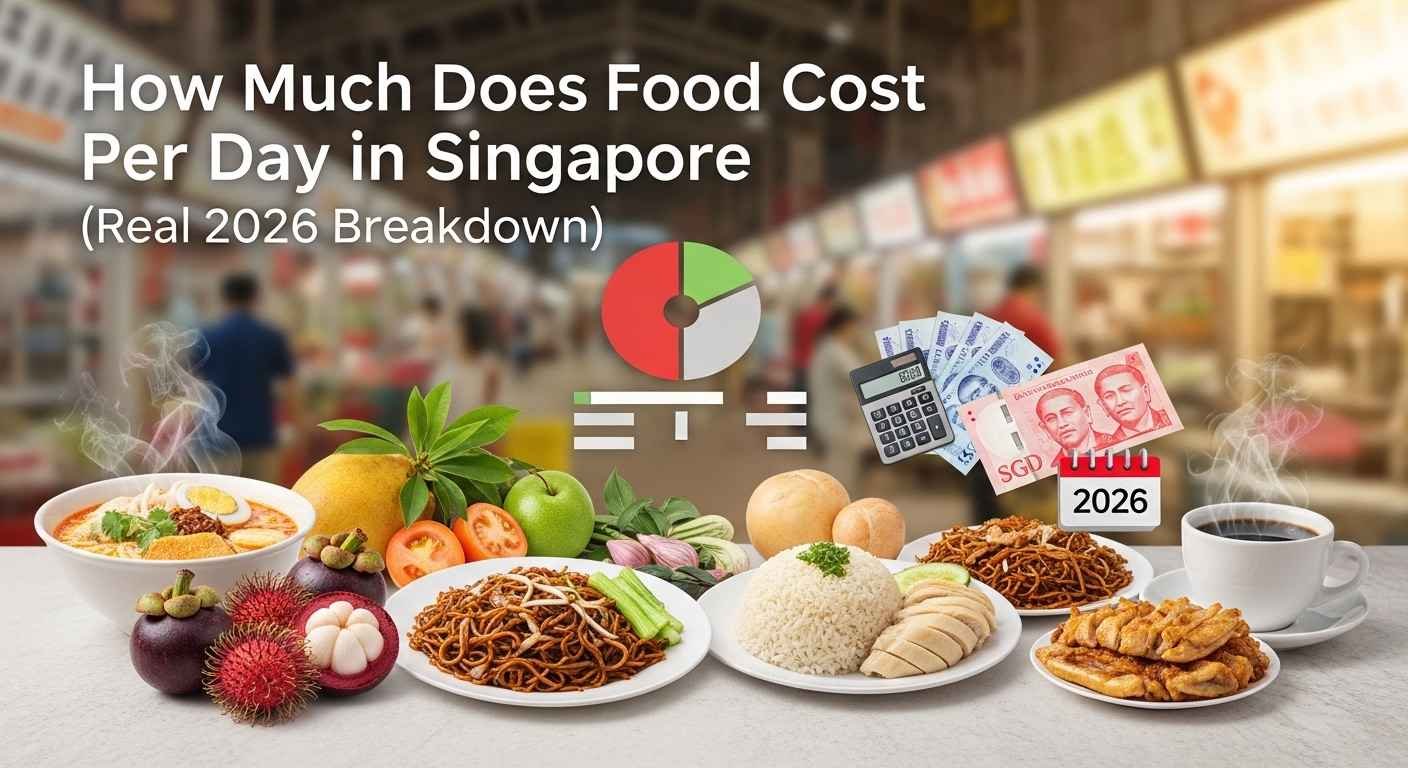
Wondering about the food cost per day in Singapore. You are not alone. Singapore is one of Asia’s priciest cities but it also has a secret weapon: world-famous hawker centres where you can eat a full, delicious meal for as little as S$4. Whether you are a budget backpacker, a working expat, or a tourist planning your trip, knowing exactly how much to budget for food in Singapore can save you from nasty surprises.
On average, the food cost per day in Singapore ranges from S$15 to S$25 for budget eaters sticking to hawker centres, S$40 to S$65 for mid-range diners mixing cafés and restaurants, and S$80 to S$150+ for those enjoying fine dining experiences. In this real 2026 breakdown, we cover every meal, every price tier, and every money-saving trick you need so you can eat well in Singapore without overspending.
Singapore Food Prices at a Glance
Before diving deep, here is a quick snapshot of what you can expect to pay for common food items and meals across different dining settings in Singapore as of 2026.
| Food Item / Meal | Approximate Cost (SGD) |
|---|---|
| Hawker centre meal (e.g., chicken rice, laksa) | S$3.50 – S$6 |
| Kopitiam / coffee shop meal | S$4 – S$8 |
| Fast food combo (McDonald’s, KFC, Burger King) | S$8 – S$12 |
| Mall food court meal | S$7 – S$12 |
| Mid-range restaurant meal (per person) | S$15 – S$30 |
| Fine dining restaurant (per person) | S$75 – S$150+ |
| Kopi (local coffee) | S$1 – S$1.80 |
| Teh tarik (milk tea) | S$1.20 – S$2 |
| Bubble tea | S$4 – S$7 |
| Bottled water (at hawker) | S$0.50 – S$1.50 |
| Beer at a restaurant | S$10 – S$16 |
| Grocery basics (one week for one person) | S$30 – S$60 |
Note: All prices are in Singapore Dollars (SGD). As of early 2026, 1 SGD ≈ 0.74 USD. Singapore imports the vast majority of its food ingredients, which means global supply chain shifts and currency fluctuations directly affect menu prices.
Understanding Singapore’s Food Landscape
Singapore’s food scene is built on three pillars: hawker centres, restaurants, and home cooking. The good news is that unlike most world-class cities, Singapore’s cheapest food tier hawker centres is genuinely excellent. Several hawker stalls have been awarded Michelin stars, including the legendary Liao Fan Hong Kong Soya Sauce Chicken Rice & Noodle Stall, which serves what many consider the cheapest Michelin-starred meal in the world.
A key thing to understand before budgeting is that Singapore imports over 90% of its food. The country has virtually no domestic agriculture, so prices are directly tied to global supply chains, shipping costs, and foreign exchange rates. This is why food inflation here has been more volatile than in many other countries. Hawker food prices spiked by 6.1% in 2023 the highest increase since 2008 before easing back. By 2025, the inflation rate for hawker food and food courts had moderated to around 1.1–1.2% year-on-year, which is a relatively healthy sign heading into 2026.
The Singapore dollar has remained relatively stable in early 2026, which is good news for both locals and visitors budgeting for meals. If you’re new to the scene, our complete Singapore food culture guide explains how Chinese, Malay, Indian, and Peranakan influences shape daily meals across the island.
Daily Food Cost by Budget Type
One of the most useful ways to look at food costs is by your overall lifestyle and spending comfort level. Here is a realistic per-day food budget breakdown across three traveler and resident profiles.
| Budget Type | Who It Suits | Daily Food Cost (SGD) | Daily Food Cost (USD approx.) |
|---|---|---|---|
| Budget / Hawker-Only | Backpackers, students, budget-conscious locals | S$15 – S$25 | ~$11 – $18 |
| Mid-Range | Tourists, expats, working professionals | S$35 – S$65 | ~$26 – $48 |
| Comfort / High-End | Business travelers, fine-dining lovers | S$80 – S$150+ | ~$59 – $110+ |
Let’s break each of these down in more detail.
Budget Eating in Singapore: S$15 – S$25 Per Day
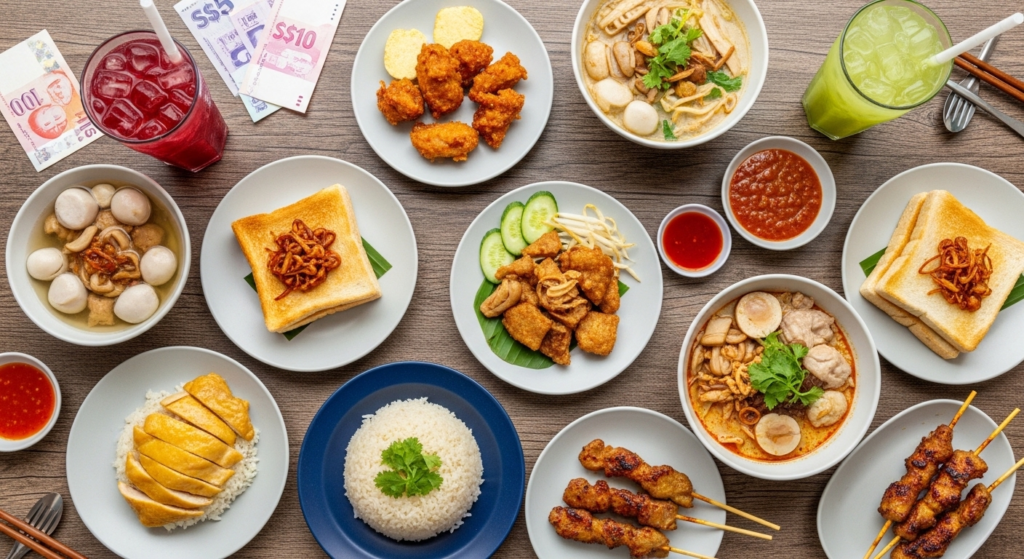
This is the hawker centre lifestyle, and it is genuinely wonderful. Hawker centres are large, open-air or semi-open food complexes operated by the government. There are over 121 of them spread across the island, making them easy to find no matter what neighbourhood you are in. They are hygienic, affordable, and culturally rich locals eat at them every single day.
A study by the Institute of Policy Studies (IPS) found that the average cost of three full meals at hawker centres, food courts, and kopitiams is about S$16.89 per day. That is a fully fed day for under S$20.
Here is what a typical budget day of eating looks like:
- Breakfast: Kaya toast with soft-boiled eggs and a kopi (local coffee) at a kopitiam — S$3 to S$4.50. This is a quintessential Singapore breakfast and unbelievably satisfying.
- Lunch: A plate of chicken rice, char kway teow, or fishball noodles at a hawker centre — S$4 to S$6. Add a canned drink for another S$1.50.
- Afternoon snack: Fresh sugar cane juice or a packet drink — S$1.50 to S$2.
- Dinner: Economical rice (pick-and-mix with rice, one meat, and two vegetables) — S$4 to S$6. This is one of the best-value meals in all of Singapore.
Total: Approximately S$15 to S$20 per day — and you will not go hungry or bored.
Popular dishes you will find in this price range include:
- Hainanese Chicken Rice (S$4–S$6) — Singapore’s unofficial national dish, simple and iconic.
- Laksa (S$4–S$6) — A rich, spicy coconut-based noodle soup that packs incredible flavour.
- Char Kway Teow (S$4–S$5.50) — Stir-fried flat rice noodles with egg, cockles, and Chinese sausage.
- Nasi Lemak (S$3.50–S$5) — Fragrant coconut rice served with sambal, fried anchovies, and egg.
- Roti Prata (S$1–S$2 per piece) — Crispy Indian flatbread served with curry dipping sauce, a beloved breakfast staple.
- Wonton Mee (S$4–S$5.50) — Egg noodles with wontons and barbecued pork.
Pro Tip: Stick to hawker centres in residential heartland areas like Ang Mo Kio, Bedok, or Clementi rather than tourist-heavy spots like Newton Food Centre or Lau Pa Sat, where the same dishes can cost 30–50% more.
Mid Range Eating in Singapore: S$35 – S$65 Per Day
Most tourists and expats fall into this category. The mid-range approach means you eat your main meals at hawker centres but occasionally splurge on a sit-down restaurant, a café brunch, or food delivery. This is the sweet spot where Singapore’s food value truly shines — you get a lot of variety and quality for a moderate daily spend. Bubble tea or specialty coffee can add S$5–S$10 per drink. If you are a coffee lover, you might enjoy reading about best coffee in Singapore and how local roasters compare.
A typical mid-range day might look like this:
- Breakfast: Café brunch or a Western breakfast at a bakery café — S$12 to S$18.
- Lunch: Hawker centre meal — S$5 to S$7.
- Bubble tea or café coffee in the afternoon — S$5 to S$7.
- Dinner: Casual restaurant meal or tze char (Chinese home-style cooking) — S$20 to S$30.
Total: Approximately S$40 to S$60 per day.
Travel data collected from real visitors to Singapore consistently puts the average food spend at around S$61 per day, with a typical range of S$19 to S$121 depending on lifestyle choices. This S$61 figure lines up well with what you would spend on a mid-range day that mixes hawker meals with one or two restaurant-level experiences.
Food delivery apps like GrabFood and Foodpanda are widely used and convenient, but come with service and delivery fees that can add S$4 to S$7 to each order. They are great for convenience, but using them daily nudges your food spend significantly upward.
High End / Fine Dining: S$80 – S$150+ Per Day
Singapore punches well above its weight in the fine dining category. The city has numerous Michelin-starred restaurants, rooftop bars, and world-class hotel dining rooms. If you are eating at this level for most meals, expect to spend between S$80 and S$150+ per day on food alone.
- A two-course meal with a glass of wine at a mid-to-high-end restaurant typically runs S$60 to S$90 per person.
- Iconic experiences like Chilli Crab at Jumbo Seafood or No Signboard Seafood can cost S$80 to S$150 for two people, depending on the size of the crab.
- Singapore Slings at the Raffles Hotel Long Bar cost around S$37 each a famous splurge that many visitors consider a must-do bucket list experience.
- Top-tier tasting menus at Michelin-starred restaurants can run S$200 to S$400 per person without wine pairing.
Meal by Meal Cost Breakdown Across Dining Settings
Here is a practical look at what breakfast, lunch, and dinner each cost on average across different dining styles.
| Meal | Hawker / Kopitiam | Food Court / Fast Food | Café / Casual Restaurant | Fine Dining |
|---|---|---|---|---|
| Breakfast | S$2.50 – S$4.50 | S$6 – S$10 | S$12 – S$20 | S$30 – S$60 |
| Lunch | S$4 – S$7 | S$7 – S$12 | S$15 – S$25 | S$50 – S$100 |
| Dinner | S$5 – S$8 | S$9 – S$14 | S$20 – S$40 | S$80 – S$200+ |
| Drinks (per drink) | S$1 – S$2 | S$2 – S$4 | S$5 – S$10 | S$12 – S$25 |
One thing to keep in mind: at sit-down restaurants in Singapore, most menus show prices before the 9% GST and 10% service charge. Always look for the “+” symbol beside prices, as it means you will pay an additional 19% on top of what is listed. This catches a lot of tourists off guard.
What About Groceries and Cooking at Home
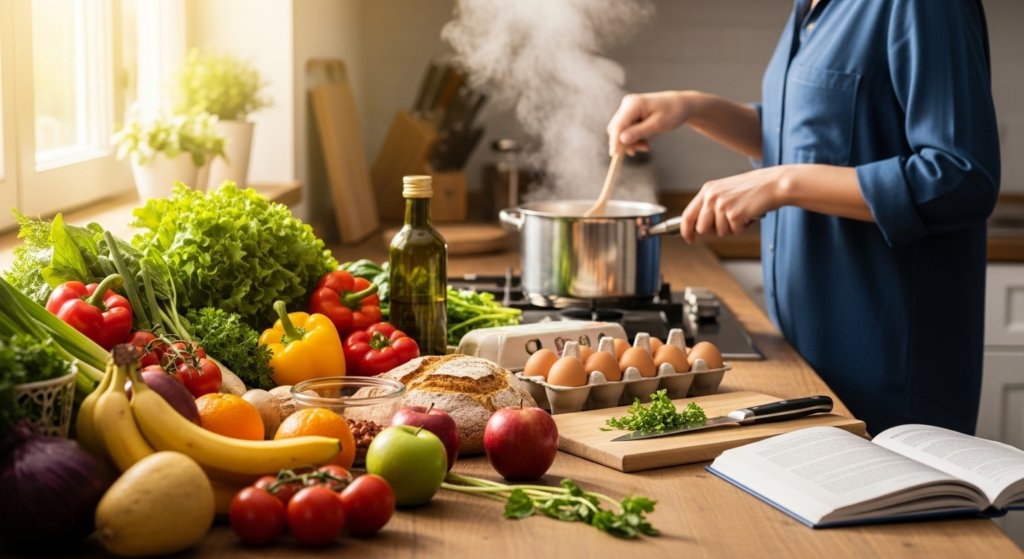
If you are living in Singapore as an expat or student, home cooking is worth factoring into your budget though it is not as cost-effective here as you might expect. Since Singapore imports almost all of its food, grocery prices are higher than in many neighbouring countries. Interestingly, you will often find that cooking a meal at home can cost nearly as much as eating at a hawker centre, without the time savings or the atmosphere.
That said, buying smartly at supermarkets can still reduce monthly food expenses meaningfully. A week’s worth of groceries for one person covering basics like rice, eggs, vegetables, chicken, and pantry staples typically costs S$30 to S$60 at NTUC FairPrice, Giant, or Sheng Siong (the main budget supermarket chains). Cold Storage caters more to imported or premium products and tends to be noticeably pricier.
Wet markets offer the freshest produce and often better prices on vegetables, fish, and meat than supermarkets. If you are in Singapore long-term, building a habit of shopping at wet markets in the morning can meaningfully bring your grocery costs down.
Hidden Food Costs to Watch Out For
Even budget-savvy eaters in Singapore can get caught off guard by a few recurring expenses:
- Bubble tea habit: It feels harmless at S$4 to S$7 per cup, but a daily bubble tea habit quietly adds up to S$120 to S$200 per month.
- Food delivery fees: GrabFood and Foodpanda charge delivery and platform service fees that can add S$4 to S$7 per order. A S$8 hawker meal ordered via delivery suddenly becomes S$14 to S$16.
- Tourist-area price premiums: Famous hawker spots frequented by tourists, like Newton Food Centre and Lau Pa Sat, often price meals 30 to 50% higher than neighbourhood equivalents for the exact same dish.
- Alcohol costs: Singapore imposes very high excise taxes on alcohol. A bottle of beer at a restaurant costs S$10 to S$16, and wine by the glass typically starts at S$15 to S$20. Alcohol can dramatically inflate your daily food bill.
- GST and service charges at restaurants: As mentioned, the combined 19% surcharge (9% GST + 10% service) at sit-down restaurants catches many visitors off guard. Always check whether menu prices are before or after these additions.
- Café premium drinks: A flat white or cold brew at a trendy café in Tiong Bahru or Dempsey Hill can cost S$7 to S$10. Drinking coffee this way daily adds S$50 to S$70 per week to your food budget.
Tourist-heavy areas can charge more. Instead of sticking only to famous locations, try discovering hidden food spots in Singapore where locals actually eat.
Money Saving Tips for Eating Well in Singapore
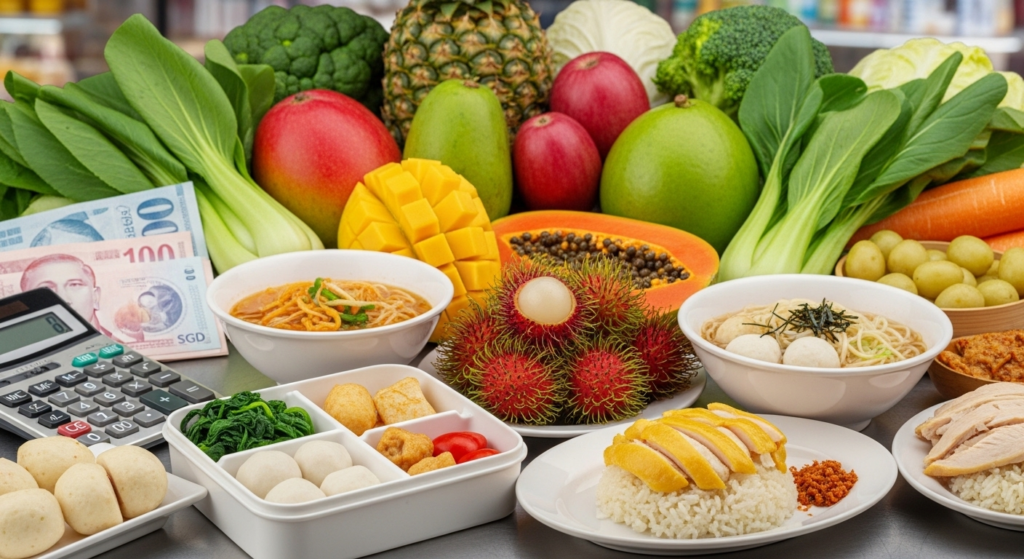
There are plenty of smart ways to eat well without overspending:
- Eat where the locals eat. Skip the touristy food centres and explore neighbourhood hawker centres in HDB residential towns. The food is often equal or better, and the price is significantly lower.
- Drink kopi, not café coffee. A local kopi from a kopitiam costs S$1.20 to S$1.80. The same volume of specialty coffee at a café will cost S$7 to S$9.
- Use the Eatigo app. This dining discount app offers up to 50% off at participating restaurants during off-peak hours a great way to try sit-down restaurants at near-hawker prices.
- Go vegetarian at hawker centres. Vegetarian stalls consistently offer some of the lowest-priced meals, sometimes S$3 to S$4 for a full plate of rice with multiple vegetable dishes. Indian vegetarian stalls are especially great value.
- Avoid delivery apps for daily meals. Delivery is convenient but comes at a real cost. Eating in person at hawker centres saves you the fees on every single meal.
- Visit wet markets early. Morning wet markets (before 10am) have the freshest produce and often the best prices on vegetables, fish, and meat.
- Buy breakfast groceries. A box of eggs (S$3 to S$4) and a loaf of bread (S$2.50 to S$4) can cover your breakfasts for an entire week if you have access to a kitchen. This alone can shave S$3 to S$5 per day off your food budget.
- Look for lunch specials. Many restaurants and food courts offer weekday lunch set menus at S$10 to S$15, which is significantly cheaper than their dinner prices for the same food.
Final Verdict: How Much Should You Budget for Food in Singapore
Here is the straightforward answer, depending on who you are:
- Budget traveler or student: Plan for S$20 to S$25 per day. Hawker centres will feed you well, cheaply, and deliciously and you will not feel like you are missing out. Three solid, flavourful meals a day is completely achievable within this range.
- Average tourist: Budget S$45 to S$65 per day. This lets you enjoy hawker staples for most meals while treating yourself to a café, a nicer dinner, or a cold beer each day without stress.
- Comfort traveler or expat with a dining-out lifestyle: Expect to spend S$80 to S$120 per day if you are regularly eating at restaurants, ordering delivery, or enjoying drinks with meals.
- Fine dining or luxury traveler: Budget S$150 per day and above Singapore’s top dining experiences are world-class and priced accordingly.
What makes Singapore uniquely impressive is that the gap between “budget eating” and “excellent eating” is unusually narrow. At S$5, a plate of chicken rice from a Michelin Bib Gourmand-recommended stall can be more satisfying than a S$30 restaurant meal elsewhere in the world. Singapore’s hawker culture is a genuine national treasure and for food lovers on any budget, it is one of the best reasons to visit.
The city rewards the curious and the adventurous eater. Do not shy away from following a queue, pointing at something you cannot read on the menu, or asking a local where they eat. That, more than anything, is how you find the best food in Singapore at the best price.