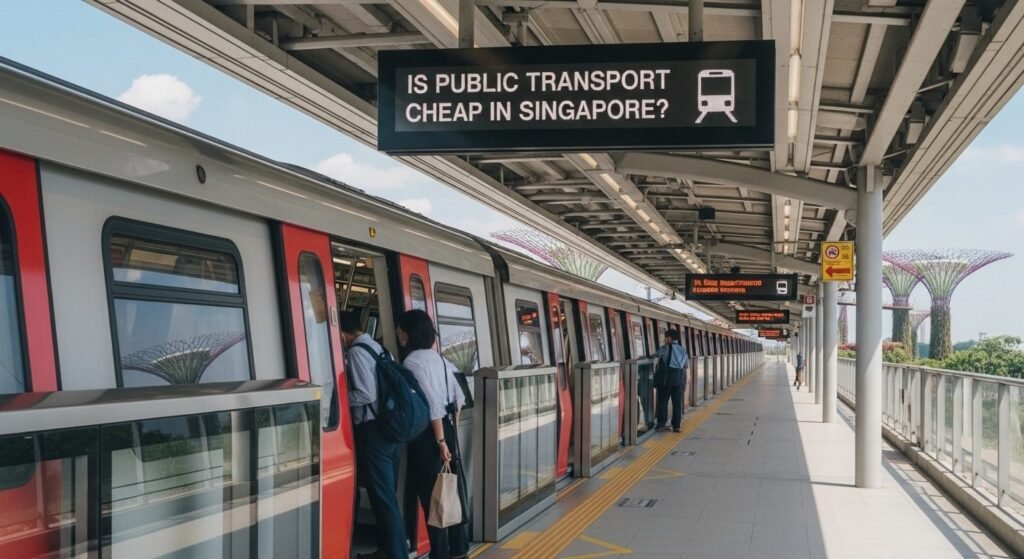
When it comes to public transport cost in Singapore, the city state stands out as one of the most affordable and efficient transit systems in Asia. Despite Singapore’s well-known high cost of living, commuters can travel across the island on buses and MRT trains for as little as SGD 1.28 per trip using an EZ Link card or SimplyGo contactless payment. The Distance Fares system means passengers are charged based on total distance travelled, and they can make transfers between buses and MRT trains without paying an additional charge each time. This makes short and medium daily commutes genuinely budget-friendly compared to owning a car which remains prohibitively expensive due to Singapore’s Certificate of Entitlement (COE) scheme.
For both residents and tourists, Singapore’s public transport is not just cheap it is remarkably good value. Monthly public transport spending for a regular commuter averages between SGD 100 to SGD 150, and heavy users can opt for unlimited monthly passes to save even more. Commuters eligible for concession fares enjoy per journey rates that are up to 70% lower than standard adult fares and children below 7 years old travel completely free. With a world-class network of MRT lines, buses, and LRT services, Singapore proves that affordable, high-quality public transport and a high-cost city can absolutely coexist.
Singapore’s Transport System at a Glance
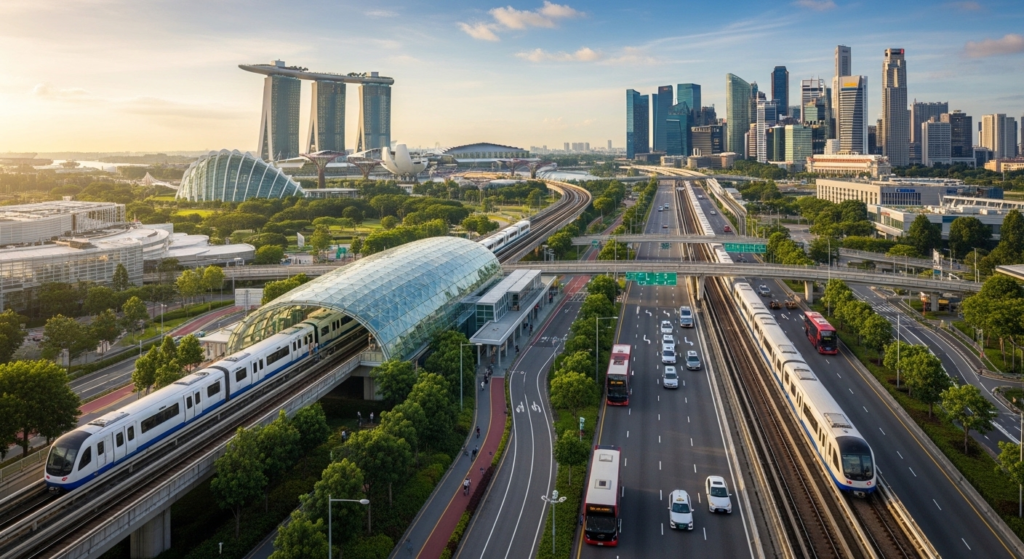
Singapore is frequently ranked among the world’s most expensive cities. Owning a car here can cost over SGD 100,000 once you factor in the Certificate of Entitlement. Yet, step onto any MRT platform or board any public bus, and the experience tells a completely different story one of clean, punctual, and surprisingly affordable travel. Learn more about the high costs of car ownership.
The public transport network is operated primarily by SBS Transit and SMRT, and governed by the Land Transport Authority (LTA) and Public Transport Council (PTC). The system includes:
- MRT (Mass Rapid Transit) — six lines: North-South, East-West, Circle, Downtown, North East, and Thomson-East Coast Line
- LRT (Light Rapid Transit) — feeder trains connecting residential towns like Bukit Panjang, Sengkang, and Punggol
- Public Buses — over 350 routes covering areas not served by rail
- Night Owl Buses — running overnight hours when MRT is closed
Transfers are free between all modes MRT, LRT, and buses so riders are charged the same no matter what combination of modes they use, or how many transfers they make.
How Are Fares Calculated
Fares are calculated based on the distances travelled between the origin and destination, and these prices increase in stages for standard non-concessionary travel. When you tap your card on boarding and again on alighting, the system automatically calculates the correct fare and refunds any overpayment upon exit. Learn more about payment methods.
Payment methods accepted:
- EZ-Link Card — costs SGD 12 and comes pre-loaded with SGD 7
- SimplyGo — tap Visa, Mastercard, or mobile wallets (Apple Pay, Google Pay) directly
- Cash — accepted only on buses but more expensive; no change given
- Singapore Tourist Pass — unlimited rides for 1 day (SGD 10), 2 days (SGD 16), or 3 days (SGD 20)
- Monthly Concession Passes — unlimited travel on basic bus and train services for a flat monthly fee
Current Public Transport Fares (2025–2026)
From 27 December 2025, card fares were raised by up to 3–4 cents per journey for concession card holders and by 9–10 cents per journey for adults. Check the full pricing details here.
Singapore Bus & MRT Card Fares by Distance (Effective Dec 2025)
| Distance Traveled | Adult Card Fare (SGD) | Student/Senior Concession (SGD) |
|---|---|---|
| Up to 3.2 km | SGD 1.28 | SGD 0.62 |
| 3.3 km – 5.2 km | SGD 1.47 | SGD 0.73 |
| 5.3 km – 8.2 km | SGD 1.63 | SGD 0.84 |
| 8.3 km – 10.2 km | SGD 1.83 | SGD 0.95 |
| 10.3 km – 15.2 km | SGD 1.97 | SGD 1.04 |
| 15.3 km – 20.2 km | SGD 2.10 | SGD 1.12 |
| Over 40 km | Up to SGD 2.28 | Up to SGD 1.29 |
Cash fares on buses start from SGD 1.90. Express buses carry a higher surcharge of up to SGD 0.50–0.60 extra per journey.
Key fare facts:
- Children below 7 travel free with a Child Concession Card
- Concession holders pay up to 70% less than standard adult fares
- Commuters can save up to 50 cents when they tap in before 7:45 AM at any rail station on weekdays (except Public Holidays) under the morning pre-peak fares scheme
- Rides from selected stations on the North East Line and Sengkang-Punggol LRT taken before 7:30 AM, and between 9:00 AM and 9:45 AM, are free
Estimated Monthly Public Transport Cost in Singapore
| Commuter Type | Mode of Travel | Est. Monthly Cost (SGD) |
|---|---|---|
| Working adult (moderate distance) | MRT + Bus (EZ-Link) | SGD 100 – SGD 150 |
| Working adult (short commute) | Bus only | SGD 60 – SGD 90 |
| Student (school + tuition) | Bus + MRT (concession) | SGD 40 – SGD 60 |
| Senior citizen | Bus + MRT (concession) | SGD 35 – SGD 55 |
| Heavy user (monthly pass) | All basic buses + trains | SGD 128 (flat rate) |
| Tourist (3-day exploration) | Tourist Pass (unlimited) | SGD 20 (3-day pass) |
Compare this to the monthly costs of running a private car in Singapore loan repayments, ERP charges, parking, fuel, and COE which can easily exceed SGD 1,500–2,000 per month. The value proposition of public transport is immediately obvious.
Public Transport Cost Comparison
| City / Country | Approximate Route | Fare in SGD |
|---|---|---|
| Singapore | Cross-island MRT | SGD 2.10 – SGD 2.28 |
| Tokyo, Japan | Tokyo to Yokohama | SGD 7.00 |
| Sydney, Australia | Central to Penrith | SGD 5.30 |
| London, UK | Victoria to Gatwick | SGD 17.00 |
| Munich, Germany | Munich to Augsburg | SGD 29.00 |
| Zurich, Switzerland | Zurich to Winterthur | SGD 15.00 |
| Kuala Lumpur | Short metro ride | SGD 0.40 – SGD 1.00 |
| Bangkok, Thailand | BTS Skytrain across city | SGD 1.50 – SGD 3.00 |
While Singapore’s fares are increasing, they remain competitive compared to many developed nations. Switzerland stands out for significantly higher transportation costs, while Japan and Australia offer fares higher than Singapore but still more affordable than Switzerland. Singapore beats almost every major Western city and Japan on cost, while delivering comparable or superior infrastructure.
Concession Fares: Who Saves the Most
The government heavily subsidizes travel for:
- Students — primary, secondary, ITE, polytechnic, and university levels
- Senior citizens — aged 65 and above
- Persons with Disabilities (PWD)
- Workfare Transport Concession Scheme (WTCS) recipients — lower-wage workers earning up to SGD 2,500/month
- Children below 7 — completely free travel
These groups get up to 70% off every single journey, or can take unlimited monthly passes at a heavily discounted flat rate.
Smart Ways to Cut Your Public Transport Cost in Singapore
- Travel before 7:45 AM on weekdays — Save up to 50 cents per trip under the Morning Pre-Peak Discount
- Use SimplyGo with a cashback card — Earn up to 8% cashback on transport spending with the right credit card
- Always tap in AND out — Ensures correct distance-based fare instead of the maximum fare
- Use free off-peak NEL/SPLRT rides — Selected North East Line and Sengkang-Punggol stations offer free rides during off-peak windows
- Buy a monthly pass if you commute heavily — Beats paying per journey for frequent travelers
- Tourist Pass for visitors — SGD 20 for unlimited 3-day travel beats per-trip fares if you’re exploring the city
- Sign up for Travel Smart Journeys (TSJ) to earn points per ride redeemable for travel credit when taking select buses during weekday morning peak hours
Is the Quality Worth the Cost

Despite being frequently criticized for having a high cost of living, Singapore’s public transportation is nevertheless remarkably affordable when compared to other major Asian cities. Beyond price, what commuters receive is world-class:
- Frequency — MRT trains run every 2–5 minutes during peak hours and 5–7 minutes off-peak
- Coverage — By 2030, 8 in 10 households will live within a 10-minute walk of an MRT station
- Comfort — All MRT trains and most buses are fully air-conditioned
- Safety — Among the safest public transit environments in the world
- Accessibility — Lifts, tactile floor paths, and priority seating throughout the system
- Global ranking — Singapore ranks 12th globally in a list of cities with the world’s best public transport, based on a survey of 18,500 people from over 50 countries
What’s Changing: New Expansions Coming
The network keeps growing. Three new Circle Line MRT stations are being built for Keppel and Shenton Way. Commuters can look forward to the completion of the Circle Line loop, and a new East Coast Integrated Depot opening in 2026, designed to enhance public transport efficiency. By 2035, three new western stations will connect the Downtown Line to the North-South Line, bringing even more coverage to Singapore’s commuters.
Conclusion
The answer to “Is public transport cheap in Singapore?” is a clear yes in context. One of the world’s greatest and most affordable public transportation networks is found in Singapore. A daily commuter can cross the entire island for under SGD 2.50. Monthly transport spending rarely exceeds SGD 150 for adults. Students and seniors pay a fraction of that.
Stack that against car ownership costs, the far higher fares of Tokyo, London, or Sydney, and the premium quality of infrastructure you get in return and Singapore’s buses and MRT trains represent genuinely exceptional value. For residents, expats, and tourists alike, public transport in Singapore is not just affordable. It is, without question, the smartest way to get around.
FAQs
1. How affordable is public transport in Singapore?
Public transport in Singapore is considered affordable, with an efficient network of buses, MRT (Mass Rapid Transit) trains, and LRT (Light Rail Transit) systems. Fares are relatively low compared to other major cities, and there are options like the EZ-Link card and contactless payment for easy access.
2. What is the cost of an MRT ride in Singapore?
The cost of an MRT ride in Singapore depends on the distance traveled. Fares start from around SGD 0.83 and can go up to SGD 2.17, making it a budget-friendly option for daily commuting.
3. Are there any discounts for public transport in Singapore?
Yes, there are discounts available for senior citizens, students, and people with disabilities. Additionally, Singapore residents can benefit from discounted fares with an EZ-Link card or by using contactless payment systems like the SimplyGo system.
4. Is it cheaper to use public transport or taxis in Singapore?
Public transport is significantly cheaper than taxis in Singapore. A typical taxi ride starts at SGD 3.90, with additional charges for distance and time, while public transport fares are generally much lower and offer a more cost-effective solution for daily commuting.
5. What are the most cost-effective ways to pay for public transport in Singapore?
The most cost-effective way to pay for public transport is by using an EZ-Link card or a SimplyGo contactless payment card. These methods offer convenience, ease of use, and provide small discounts compared to paying cash.
6. Are there any monthly passes for public transport in Singapore?
Yes, Singapore offers monthly travel passes for frequent commuters. The Adult Monthly Travel Pass provides unlimited rides on public buses and trains for a fixed monthly fee, making it a great option for those who travel daily.
7. How does public transport pricing in Singapore compare to other countries?
Public transport in Singapore is relatively cheap when compared to other major cities, especially those in Western countries. The fare structure is designed to be affordable for both locals and tourists, while still maintaining high quality and efficiency.
8. Is Singapore’s public transport affordable for tourists?
Yes, Singapore’s public transport is affordable for tourists. Visitors can purchase the Singapore Tourist Pass, which offers unlimited rides on the MRT and public buses for a set number of days, making it an excellent option for tourists looking to explore the city on a budget.