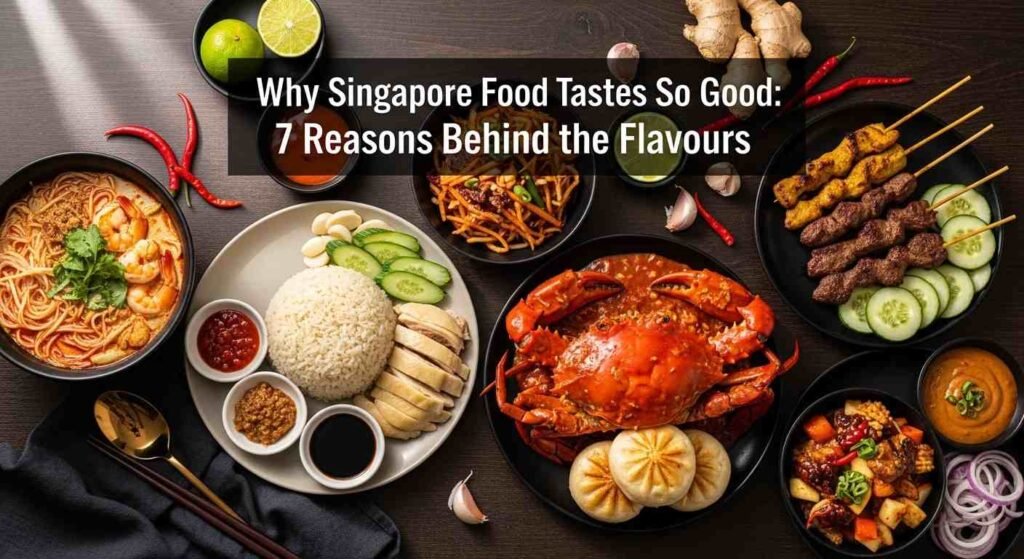
Singapore food tastes so good because it is the result of centuries of cultural fusion, hyper-specialised cooking techniques, and an uncompromising obsession with freshness and flavour. A tiny island nation positioned at the crossroads of Chinese, Malay, Indian, and Peranakan culinary traditions, Singapore has evolved a food culture that is unlike anywhere else in the world. Every dish from the silky Hainanese Chicken Rice to a smoky plate of Char Kway Teow carries layers of history, identity, and craft that most cuisines cannot replicate.
The secret behind why Singapore food tastes so good lies in seven powerful factors: its multicultural heritage, the mastery of hawker-stall cooking, the prized concept of “wok hei,” the use of intensely fragrant spice pastes, ultra-fresh tropical ingredients, government-supported food culture, and a competitive food market that pushes every cook to their best. Together, these elements create a dining experience that has earned Singapore two Michelin-starred hawker stalls, a UNESCO heritage listing, and a global reputation as the world’s greatest food city.
A City Built on Flavour
Ask any seasoned traveller to name the world’s best food destination, and Singapore will almost always appear at or near the top of the list. For a country with no agricultural land and barely 700 square kilometres of territory, Singapore punches extraordinarily far above its weight when it comes to cuisine. But why does Singapore food taste so good. The answer is not simple it is a delicious convergence of history, culture, technique, ingredients, and a fierce national passion for eating.
In this article, we explore the seven defining reasons that make Singapore food exceptional. Whether you are planning a trip, a food lover doing research, or simply curious after tasting your first plate of laksa this deep dive will satisfy your hunger for answers.
Reason 1: A Melting Pot of Culinary Cultures
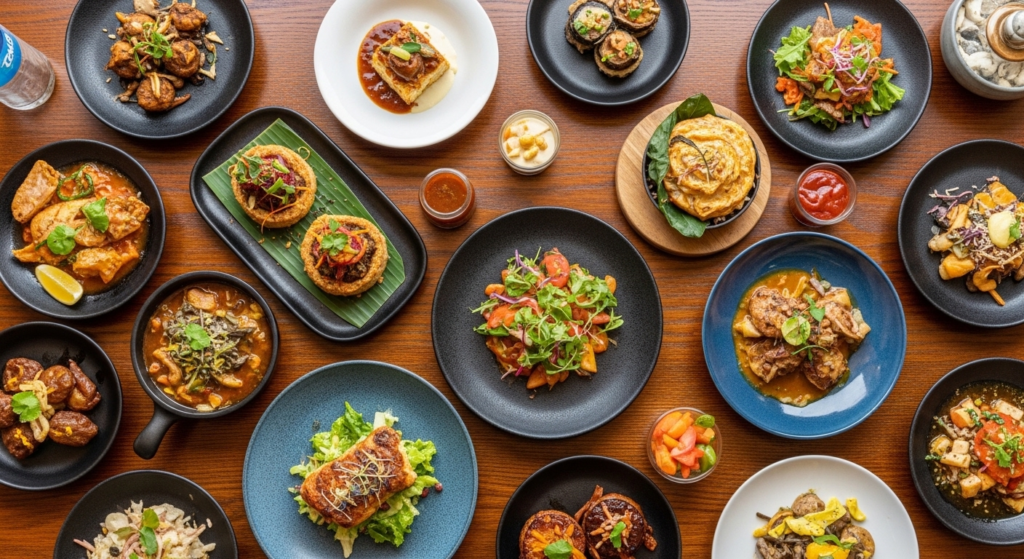
The single most important reason why Singapore food tastes so good is its multicultural DNA. Singapore is home to three major ethnic communities Chinese, Malay, and Indian each bringing a distinct and rich food tradition to the table. Over generations, these traditions did not simply coexist; they cross-pollinated, adapted, and merged to create entirely new flavour combinations.
This cultural exchange gave birth to iconic dishes such as Laksa (a Chinese-Malay fusion of rice noodles in coconut curry broth), Roti Prata (South Indian flatbread now eaten with curry or even chocolate sauce), and the extraordinary Peranakan cuisine a blend of Chinese and Malay traditions developed by Straits Chinese settlers over 500 years. Many of these dishes have become globally recognised icons. If you want to explore the most famous ones, check our guide to the most famous hawker dishes in Singapore.
Key cultural influences that shaped Singapore’s food identity:
- Chinese immigrants from Fujian, Teochew, Hainanese, and Cantonese regions brought distinct noodle and rice traditions
- Malay culture introduced the use of rich coconut milk, fragrant lemongrass, and fiery sambal chilli
- Indian traders contributed deep spice blends, curry leaves, tamarind, and tandoor cooking
- Peranakan (Nyonya) cuisine emerged as a sophisticated fusion, combining Chinese techniques with Malay spices
- British colonial influence introduced kaya toast culture and the beloved “kopitiam” (traditional coffee shop)
Singapore’s Key Ethnic Influences on Food
| Ethnic Group | Key Ingredients | Famous Dishes | Flavour Profile |
| Chinese | Soy sauce, tofu, pork, noodles | Char Kway Teow, Hainanese Chicken Rice | Umami, savoury, subtle |
| Malay | Lemongrass, coconut, belacan, chilli | Nasi Lemak, Rendang, Satay | Rich, spicy, aromatic |
| Indian | Curry leaves, mustard seeds, tamarind | Roti Prata, Fish Head Curry, Biryani | Bold, spiced, tangy |
| Peranakan | Candlenuts, galangal, pandan | Laksa, Ayam Buah Keluak | Complex, layered, fragrant |
Reason 2: The Hawker Centre A World Class Food Institution
No discussion of why Singapore food tastes so good is complete without celebrating the hawker centre. These open-air, government-managed food courts are the beating heart of Singapore’s culinary identity. Unlike fast food or casual dining, hawker stalls are run by individual masters who have dedicated their entire careers often 20 to 40 years to perfecting a single dish.
In 2020, Singapore’s hawker culture was inscribed on UNESCO’s Representative List of the Intangible Cultural Heritage of Humanity a landmark recognition that confirmed what Singaporeans already knew: hawker food is not street food, it is high art. If you want to understand why these food centres are so culturally significant, our detailed article on hawker culture in Singapore explains how they became the foundation of the nation’s food identity.
What makes hawker stalls produce such outstanding food:
- Extreme specialisation one stall, one dish, mastered over decades
- Recipes passed down through families, preserving authentic techniques
- No shortcuts stocks are boiled for hours, pastes ground fresh daily
- High-volume cooking that sharpens skill and consistency
- Competitive environment where quality directly determines survival
- Affordable prices mean even the finest preparations are accessible to everyone
Must Try Singapore Dishes and Why They Taste Exceptional
| Dish | Secret Behind the Taste | Where to Find the Best |
| Hainanese Chicken Rice | Poached in aromatic stock, served with ginger-chilli sauce | Tian Tian Hawker Centre, Maxwell Food Centre |
| Laksa | Coconut milk broth with rempah spice paste | 328 Katong Laksa, Sungei Road Laksa |
| Chilli Crab | Fresh crab tossed in tomato-chilli-egg gravy | Long Beach Seafood, Jumbo Seafood |
| Char Kway Teow | Wok hei from high-heat frying in pork lard | Hill Street Fried Kway Teow, Old Airport Road |
| Satay | Marinated meat grilled over charcoal, peanut sauce | Lau Pa Sat, Satay by the Bay |
Reason 3: The Magic of Wok Hei
Wok hei literally translated as “breath of the wok” is a uniquely Chinese-Singaporean concept that refers to the smoky, slightly charred, intensely savoury aroma that comes from cooking in a searing-hot wok over a raging flame. It is the single quality that separates an extraordinary plate of Char Kway Teow or Fried Hokkien Mee from an ordinary one.
Achieving true wok hei is extraordinarily difficult. It requires a cast iron or carbon steel wok, a gas burner powerful enough to reach temperatures exceeding 300°C, and a cook skilled enough to toss ingredients rapidly while managing heat, timing, and seasoning simultaneously. The Maillard reaction — the chemical browning that occurs at high heat creates hundreds of new flavour compounds in seconds, producing a complexity that low-heat cooking simply cannot replicate.
Why wok hei is almost impossible to recreate at home:
- Home stoves produce a fraction of the BTU power used in hawker stalls
- Overcrowding the wok common at home causes steaming instead of frying
- The technique requires years of muscle memory to perfect
- The right combination of pork lard, soy sauce, and timing is learned through practice, not recipes
Reason 4: The Power of Rempah Spice Paste Mastery
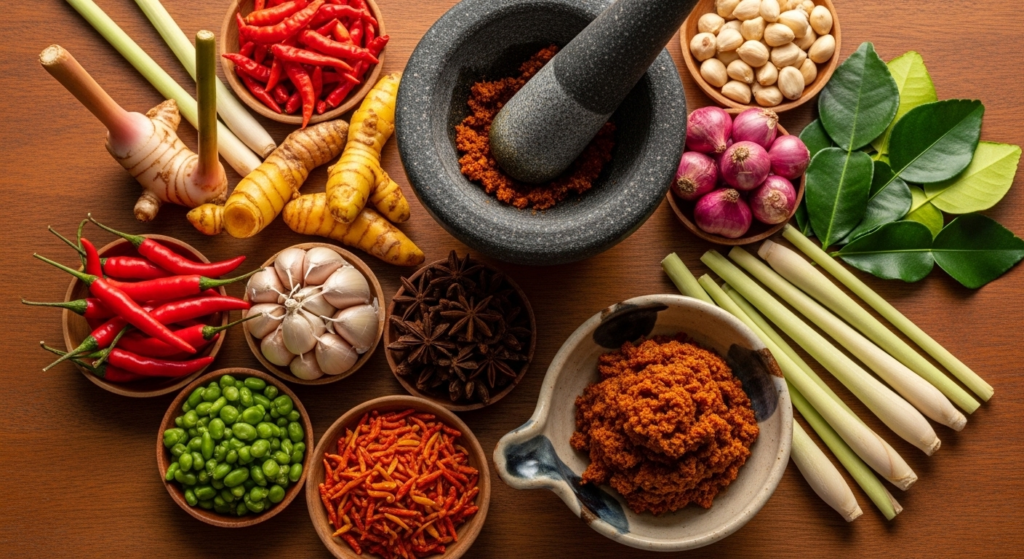
Rempah is the Malay word for spice paste, and it is the foundation of countless Singaporean dishes. A well-made rempah typically containing shallots, garlic, galangal, lemongrass, dried chillies, belachan (fermented shrimp paste), and candlenuts must be pounded in a mortar until it becomes a smooth, fragrant paste and then fried in oil until it is “tumis” (cooked out), releasing its full aromatic potential.
This process, called “menumis” or blooming the spice paste, is where the deep flavour foundation of dishes like Laksa, Rendang, and Curry is built. The difference between a freshly pounded rempah and a commercially blended one is immediately detectable to any trained palate. Singapore’s obsession with doing this step correctly is a defining reason why Singapore food tastes so good.
Core ingredients commonly found in Singaporean spice pastes:
- Shallots — sweetness and body
- Fresh galangal — a citrusy, pine-like heat distinct from regular ginger
- Lemongrass — bright, grassy, floral aromatics
- Dried and fresh chillies — heat with fruity depth
- Belachan (shrimp paste) — pungent umami backbone
- Candlenuts — creamy texture and subtle nuttiness
- Turmeric — earthy colour and anti-inflammatory warmth
- Kaffir lime leaves and pandan — uniquely Southeast Asian fragrance
Reason 5: Tropical Freshness and Superior Ingredients
Singapore’s geographical location in equatorial Southeast Asia means it has access to some of the freshest and most flavourful tropical produce in the world. Ingredients like pandan leaf, kaffir lime, fresh coconut, ripe mango, banana flower, and jackfruit grow in abundance across the region and arrive at Singapore’s wet markets at peak freshness daily. Interestingly, many visitors notice that food in Singapore tastes noticeably different from other countries. We explored the science behind this in our article on why Singapore food tastes different.
Wet markets traditional markets where fresh meat, seafood, and vegetables are sold remain a cornerstone of Singapore’s food supply chain despite the city’s modernity. Chefs and hawker stallholders shop at wet markets early every morning, selecting the freshest crabs, the most fragrant herbs, and the plumpest prawns for the day’s cooking. This commitment to ingredient quality is non-negotiable in Singapore food culture.
Key fresh ingredients that elevate Singapore dishes:
- Live seafood — Sri Lankan crabs, tiger prawns, and flower crabs bought alive for dishes like Chilli Crab
- Fresh coconut milk — squeezed daily for Nasi Lemak and Laksa, never from a carton
- Pandan leaves — used fresh to infuse rice, cakes, and drinks with a sweet, grassy aroma
- Fresh tofu — silken tofu made daily in traditional workshops across the island
- Seasonal tropical fruits — durian, rambutan, mangosteen used in desserts and sauces
Reason 6: A Competitive and Government Supported Food Culture
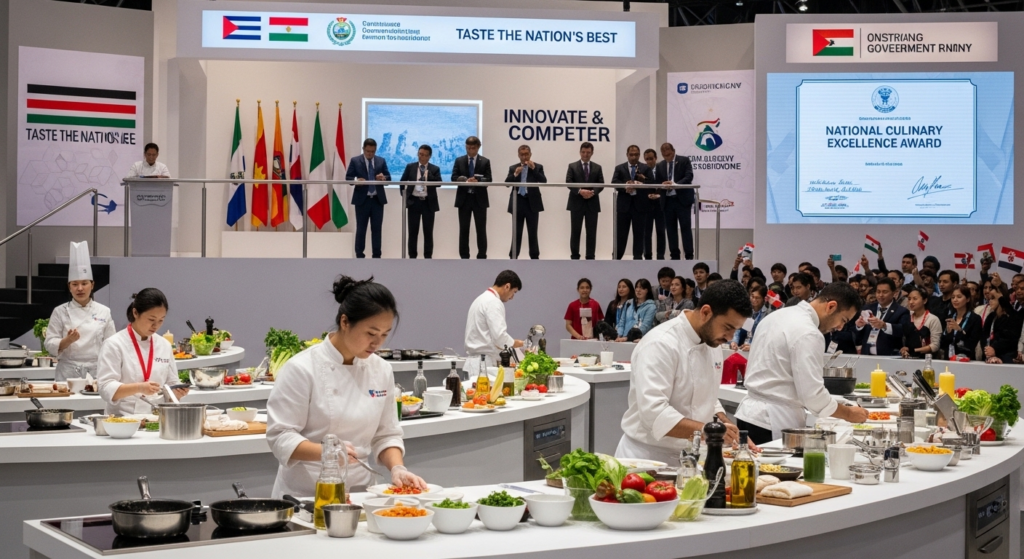
Singapore’s food scene is uniquely shaped by both fierce market competition and active government support. The hawker centre system itself was established by the Singapore government in the 1970s, as part of a public health initiative to relocate street vendors into managed, hygienic food centres. This policy decision often overlooked was transformative: it gave hawkers permanent, affordable stalls, enabling them to invest in their craft rather than worrying about survival.
Today, the government continues to support hawker culture through grants for young hawkers, heritage conservation programmes, and events like the Singapore Food Festival. Meanwhile, the extremely competitive food market where a stall’s reputation lives and dies by word of mouth creates relentless pressure to maintain quality. Mediocrity is punished swiftly in Singapore; excellence is rewarded with queues that stretch for hours.
How competition drives quality in Singapore’s food scene:
- A single poor review on food apps or social media can devastate a stall’s business overnight
- Queues of 30–60 minutes are seen as a badge of honour and a quality signal
- Michelin Guide Singapore was launched in 2016, elevating local hawker recognition globally
- Multiple stalls serving the same dish compete side by side, forcing each to differentiate through quality
- Singapore’s food blogger and reviewer community is among the most active in Asia
Reason 7: Singapores Eating Culture Food is a National Obsession
Perhaps the deepest reason why Singapore food tastes so good is simpler than any technique or ingredient: Singaporeans care about food more than almost anything else. Eating is not just sustenance in Singapore it is a social ritual, a cultural identifier, a topic of daily conversation, and a source of fierce national pride.
The Singlish phrase “shiok” meaning intensely pleasurable, often used specifically about food captures the emotional relationship Singaporeans have with their cuisine. Locals will travel across the island for a bowl of the “right” laksa. They will debate passionately about which chicken rice is the best. They will queue an hour for a plate of char kway teow they have eaten a hundred times. This obsessive, loving relationship with food creates a culture where cooks are motivated not just by profit, but by the deep desire to feed people something truly extraordinary.
Signs of Singapore’s deep food culture:
- Food is the most common conversation topic even before “hello,” Singaporeans ask “have you eaten?”
- The country has more restaurants and food establishments per capita than almost any nation
- Singapore hosts multiple world-class food events including the World Gourmet Summit and Savour Food Festival
- Food photography and food review blogs are a significant part of local media and social culture
- Singaporean food diaspora communities around the world passionately recreate home dishes proving the emotional depth of attachment
Hawker Centre vs Restaurant Dining in Singapore
| Feature | Hawker Centre | Restaurant |
| Average Meal Cost | SGD $3 – $6 | SGD $20 – $60+ |
| Specialization | Single stall master, 20–40 years of expertise | Broad menu, varied quality |
| Freshness | Cooked to order, no batch cooking | Often pre-prepared |
| Authenticity | Recipes passed down through generations | Often adapted for wider appeal |
| UNESCO Recognition | Yes listed as Intangible Cultural Heritage (2020) | No |
Conclusion
So, why does Singapore food taste so good? Because it is the product of everything great about food culture compressed into one extraordinary place. It is history tasted in a bowl of Laksa. It is engineering felt in the breath of a wok. It is community experienced around a hawker centre table at midnight. It is pride served on a banana leaf.
Singapore’s food excellence is not accidental it is the result of centuries of cultural exchange, decades of craft mastery, a government that understood food’s cultural importance, and a population that has elevated eating to a national art form. Whether you are visiting for the first time or returning for the hundredth, Singapore’s food never disappoints because every plate is made by someone who has given their life to getting it right.
The next time you take a bite of Hainanese Chicken Rice or slurp a bowl of Laksa, you are not just eating food. You are tasting 700 years of history, the dedication of generations of hawker masters, and the beautiful, irreplaceable culture of one of the world’s greatest cities. That is why Singapore food tastes so good and why, once you have had it, no other city’s food will ever quite measure up.