

Hawker food in Singapore is the heart of the nation’s culinary identity affordable, authentic, and deeply rooted in multicultural heritage. From fragrant chicken rice and spicy laksa to satay, char kway teow, and roti prata, Singapore’s hawker centres bring together Chinese, Malay, Indian, and Peranakan flavours under one roof. Recognised by UNESCO as an Intangible Cultural Heritage, hawker culture represents more than street food; it reflects everyday life, social connection, and the preservation of traditional recipes passed down through generations.
What makes hawker food in Singapore exceptional is its combination of world-class taste, hygiene standards, and accessibility. Locals and tourists alike rely on hawker centres for quick meals that deliver restaurant-quality flavours at budget-friendly prices. Whether you are exploring iconic spots like Maxwell Food Centre, Lau Pa Sat, Chinatown Complex, or neighbourhood markets, Singapore’s hawker stalls offer an unmatched food experience built on freshness, skill, and cultural authenticity. This guide explores the history, signature dishes, and why hawker food remains the soul of Singapore’s food scene.
What Is Hawker Food in Singapore
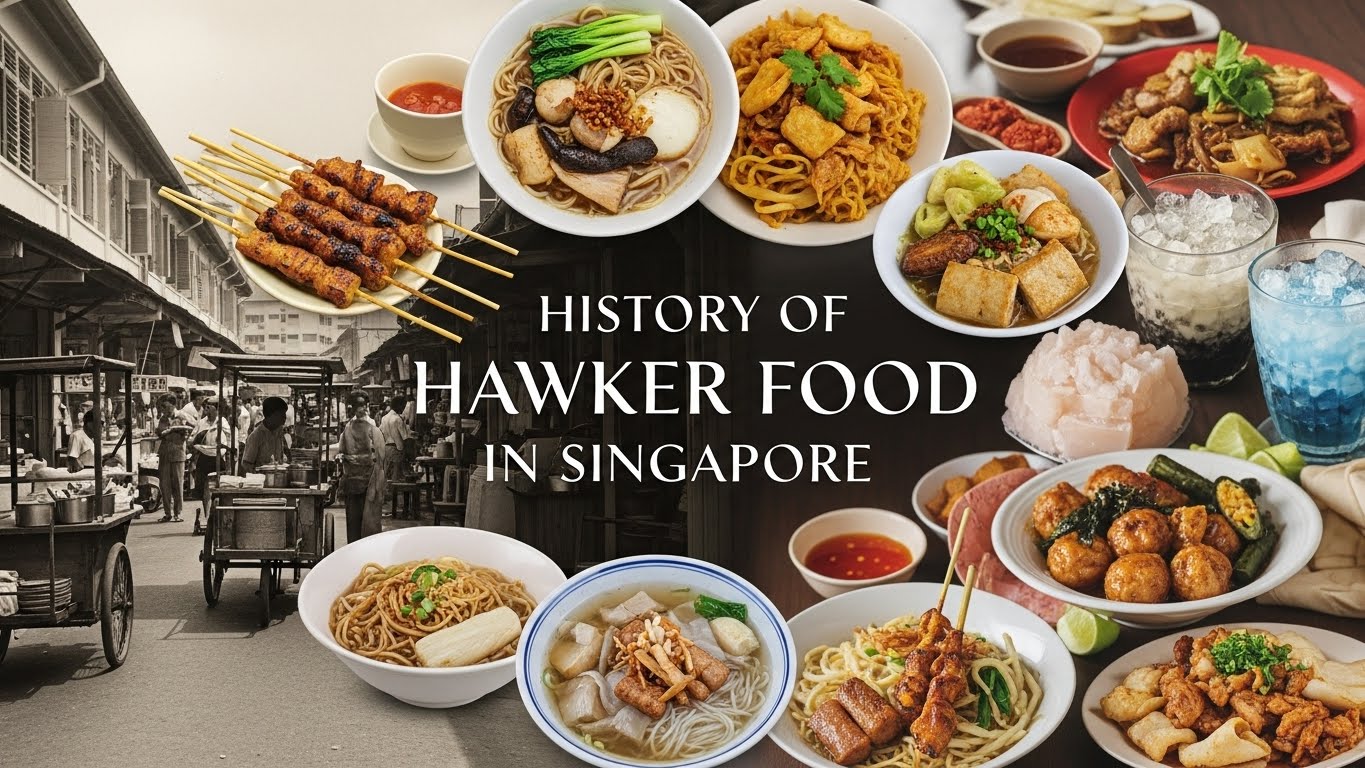
Hawker food refers to freshly prepared, affordable meals sold by individual vendors known as hawkers operating within open-air food complexes called hawker centres. These centres house dozens, sometimes hundreds, of stalls, each specialising in a small range of dishes such as Hainanese chicken rice, laksa, char kway teow, roti prata, satay, or nasi lemak.
What makes Singapore’s hawker culture distinct is not just variety or price, but structure. Unlike many street-food scenes worldwide, Singapore’s hawkers operate within a formal system of licensing, hygiene standards, and stall allocation. This allows traditional recipes to thrive while maintaining food safety, consistency, and accessibility for all income levels.
Many of these dishes are also featured in our curated list of most famous traditional Singapore food dishes, which highlights what locals consider true national favourites
Origins of Hawker Culture

Hawker culture began as a way for ordinary people to earn a living by selling simple, affordable food on the streets. Migrants from China, India, and the Malay Archipelago brought their home recipes and adapted them for busy urban life. These early hawkers served workers, labourers, and travellers who needed quick, filling meals. Over time, street food became a daily part of community life.
In Singapore, hawking grew rapidly in the 19th and early 20th centuries as the population expanded. Food sellers gathered near docks, markets, and housing areas where demand was high. Although conditions were basic, the food was flavourful, diverse, and accessible to everyone. This foundation shaped the rich, multicultural hawker culture seen today.
Migrant Roots and Street Commerce
The story of hawker food begins in the 19th century, when Singapore grew rapidly as a trading port under British colonial rule. Waves of immigrants primarily Chinese, Malay, Indian, and later Peranakan communities arrived in search of work. Many lacked capital to open shops, so they sold cooked food from pushcarts, baskets, and makeshift stalls along roadsides, near docks, markets, and labour quarters.
Each community brought its own culinary traditions:
- Chinese hawkers sold noodles, congee, dumplings, and stir-fries.
- Malay vendors prepared nasi lemak, satay, and kuih.
- Indian hawkers offered roti, curries, and spice-rich snacks.
- Peranakan cooks blended Chinese and Malay flavours into dishes like laksa and ayam buah keluak.
These hawkers provided inexpensive meals to dock workers, rickshaw pullers, and shop assistants filling a critical gap in urban food supply.
Challenges of the Street Food Era
While hawker food became popular, it also created urban challenges. Vendors operated without fixed locations, often obstructing traffic. Sanitation was inconsistent, waste disposal was limited, and overcrowding raised concerns about public health. By the 1930s and 1940s, the colonial government attempted partial regulation, but enforcement remained uneven.
Despite these issues, hawker food became deeply embedded in daily life. It was fast, cheap, and reflective of Singapore’s multicultural makeup laying the foundation for a unique culinary identity.
Government Reform and Urban Planning
After gaining self-governance in 1959 and full independence in 1965, Singapore’s government faced pressing challenges: housing shortages, public hygiene, and economic development. Street hawking, while culturally significant, was seen as incompatible with a modern city.
Rather than eliminate hawkers, authorities formalised the trade. Beginning in the 1960s, the government launched a nationwide programme to:
- Register hawkers
- Provide fixed stalls
- Introduce hygiene standards
- Relocate street vendors into purpose-built hawker centres
These centres were integrated into public housing estates and town hubs, ensuring that every neighbourhood had access to affordable meals.
The Impact of Hawker Centres
This shift fundamentally changed Singapore’s food landscape:
- Sanitation improved through clean water supply, waste management, and food safety rules.
- Affordability was preserved, as stall rentals were kept low.
- Culinary diversity flourished, with each stall specialising in a few dishes rather than broad menus.
By the 1970s, hawker centres had replaced most street vending, turning informal street food into an organised, accessible, and trusted food system.
How Hawker Food Shaped Singapores National Identity

Hawker centres became more than places to eat they became social institutions. Office workers, students, retirees, and families all shared the same tables. Unlike restaurants divided by price or class, hawker centres were egalitarian spaces where everyone ate side by side.
This daily interaction across social and ethnic lines helped foster:
- Social cohesion
- Shared cultural identity
- Pride in local cuisine
Many stalls remained family-run for generations, preserving recipes and techniques passed down through decades. Hawker food became a living archive of Singapore’s migrant heritage, reflecting how diverse communities shaped a common national culture.
This everyday communal dining also explains why Singapore food often feels distinctive to visitors. Our article on why Singapore food tastes different explores how heritage, cooking techniques, and ingredients combine to create flavours found nowhere else
UNESCO Recognition
In 2020, Singapore’s hawker culture was inscribed on UNESCO’s Representative List of the Intangible Cultural Heritage of Humanity. This recognition was not for specific dishes, but for the social practice of communal dining, knowledge transmission, and the role hawker centres play in everyday life.
UNESCO highlighted:
- The affordability of hawker food
- Its multicultural roots
- The way recipes are preserved through mentorship and family traditions
- The community role of hawker centres as social meeting points
This global acknowledgment elevated hawker food from everyday sustenance to a symbol of Singapore’s cultural identity.
Evolution of Hawker Food in the Modern Era

Technology and Modern Operations
Today’s hawker centres are a blend of tradition and innovation. Many stalls now accept digital payments, operate online pre-orders, and use delivery platforms. Younger hawkers are introducing modern branding while maintaining classic flavours.
Michelin Starred Hawkers
In a remarkable development, some hawker stalls have earned Michelin stars, proving that excellence is not defined by luxury settings. This global attention has increased respect for hawkers as skilled culinary professionals.
Ongoing Challenges
Despite success, the hawker industry faces:
- Rising ingredient costs
- Aging hawker population
- Recruitment of younger generations
- Balancing affordability with sustainability
To address this, the government and industry groups offer training grants, rental subsidies, and incubator programmes for new hawkers.
Key Milestones in the History of Hawker Food
The development of hawker culture can be clearly understood through its major historical phases:
| Era | Period | Key Developments |
|---|---|---|
| Street Hawking Era | 1800s–1940s | Migrant vendors sell food from pushcarts and roadside stalls |
| Early Regulation | 1950s | Registration of hawkers; attempts to improve hygiene |
| Hawker Centre Development | 1960s–1970s | Relocation of street vendors into organised hawker centres |
| Institutionalisation | 1980s–2000s | National standards for hygiene, licensing, and stall management |
| Global Recognition | 2010s–present | Michelin recognition, UNESCO listing, cultural preservation efforts |
This structured evolution is what differentiates Singapore’s hawker culture from informal street-food systems elsewhere.
Iconic Hawker Centres and Their Historical Significance
Some hawker centres are especially symbolic of Singapore’s culinary journey. They represent different eras of development, neighbourhood identity, and food traditions.
| Hawker Centre | Established | Cultural Significance |
|---|---|---|
| Lau Pa Sat | 19th century (redeveloped later) | One of Singapore’s oldest food landmarks; blend of colonial architecture and local cuisine |
| Maxwell Food Centre | 1970s | Famous for Hainanese chicken rice and traditional stalls |
| Chinatown Complex | 1980s | Largest hawker centre; reflects Chinese culinary heritage |
| Tiong Bahru Market | 1950s (rebuilt later) | Known for classic recipes and neighbourhood identity |
| Old Airport Road Food Centre | 1970s | Renowned for veteran hawkers and heritage dishes |
Each centre tells a different chapter of Singapore’s food history, from colonial roots to public housing integration.
Traditional Dishes That Define Hawker Culture
Certain dishes have become synonymous with Singapore’s hawker identity. These foods embody the fusion of cultures and the philosophy of simple, affordable excellence.
| Dish | Cultural Origin | Why It Matters |
|---|---|---|
| Hainanese Chicken Rice | Chinese | National favourite; simple ingredients with refined technique |
| Laksa | Peranakan | Fusion of Chinese noodles with Malay spices and coconut milk |
| Char Kway Teow | Chinese | Working-class roots; smoky wok-fried noodles |
| Satay | Malay/Indonesian | Street-food tradition; communal grilling and sharing |
| Roti Prata | Indian | Affordable flatbread; reflects South Asian influence |
These dishes are not just popular they are cultural markers passed from one generation of hawkers to the next.
Why Hawker Food Remains Essential Today

Affordability and Accessibility
In a global city known for high living costs, hawker food remains one of the few areas where affordability is protected. Meals are priced for everyday consumption, ensuring no group is excluded. Many hawker meals also feature prominently in our round-up of budget-friendly Singapore food, making quality dining accessible to everyone
Community and Social Life
Hawker centres continue to function as neighbourhood meeting spaces. Birthdays, family dinners, business lunches, and casual catch-ups all happen at shared tables.
Tourism and Cultural Identity
For visitors, hawker centres offer an authentic introduction to Singapore’s food culture. Unlike fine-dining establishments, they showcase the nation’s true culinary roots.
The Future of Hawker Culture in Singapore
Sustainability and Youth Participation
To ensure continuity, Singapore is investing in:
- Training schemes for young hawkers
- Incubator stalls with reduced rent
- Promotion of environmentally sustainable practices
Preserving Heritage in a Digital Age
While technology changes how food is ordered and paid for, the core values of hawker culture craft, community, and affordability remain constant. The challenge ahead is balancing modern efficiency with the preservation of culinary traditions.
Conclusion
The history of hawker food in Singapore is a story of survival, community, and cultural pride. What began as informal street vending by immigrants has evolved into a nationally protected culinary heritage, recognised by UNESCO and deeply embedded in everyday life. From humble pushcarts to modern hawker centres, Singapore’s food culture reflects the country’s multicultural roots, where Chinese, Malay, Indian, and Peranakan flavours coexist in one shared dining space. Each dish carries more than taste it carries identity, memory, and tradition.
As Singapore continues to modernise, hawker food remains a vital link between past and present. Government support, digital innovation, and youth involvement are helping to preserve this tradition while adapting it for future generations. Whether enjoyed at a neighbourhood centre or a Michelin-listed stall, hawker food is not just affordable comfort it is a living cultural legacy that defines what it means to eat, gather, and belong in Singapore.
FAQs
1.What is hawker food in Singapore?
Hawker food refers to affordable, freshly prepared meals sold at hawker centres across Singapore. These centres bring together stalls offering Chinese, Malay, Indian, and other regional cuisines in one open, communal space.
2.When did hawker food begin in Singapore?
Hawker food traces back to the early 19th century, when street vendors sold meals to labourers, dock workers, and urban residents. It became more organised in the 1960s–1970s when the government relocated hawkers into purpose-built centres for hygiene and safety.
3.Why is Singapore’s hawker culture important?
Hawker culture represents Singapore’s multicultural identity, social equality, and food heritage. It provides high-quality meals at low cost while preserving traditional recipes passed down through generations.
4.What did UNESCO recognise about Singapore hawker food?
In 2020, UNESCO inscribed Singapore’s hawker culture on its Representative List of the Intangible Cultural Heritage of Humanity, recognising its role in community bonding, cultural diversity, and everyday social life.
5.Are hawker centres different from food courts?
Yes. Hawker centres are government-regulated public spaces focused on affordable local food and traditional recipes. Food courts are privately operated, often located in malls, and typically charge higher prices with more commercialised offerings.
6.Is hawker food only local cuisine?
While it mainly features local and regional dishes, many hawker centres also include international flavours such as Western grills, Japanese donburi, Korean dishes, and fusion concepts, reflecting Singapore’s global influence.
7.How is hawker culture being preserved today?
Preservation efforts include government grants, hygiene standards, training programmes for young hawkers, and digital ordering systems. Media, tourism promotion, and culinary awards also help raise global awareness.
8.Is hawker food healthy?
Many hawker dishes are freshly prepared with balanced ingredients, but health varies by dish. Singapore has introduced the Healthier Choice Programme to encourage stalls to offer lower-salt, lower-oil, and nutrient-balanced options.